How to choose a trail camera
Work through these in order. Each one eliminates options, and most hunters get the order backwards — they shop megapixels first, which is the spec that matters least.
1. Cellular, or walk in?
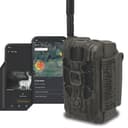
This is the gate, and it is not really a question about cameras. It is a question about how much intrusion the spot can absorb. Every SD-card check means a trip in: your scent on the ground, your boots on the trail, your shape under the camera. On a field edge you can reach from a truck, that costs nothing. On a bedding-area entrance, a card check in October is a wasted week. A cellular camera is worth the subscription exactly where you cannot afford to walk in — and is a luxury everywhere else.
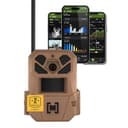
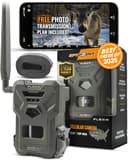
Price it honestly. The camera is a one-time number; the plan renews. Over three seasons on several cameras, the plans usually cost more than the hardware, which is why one cellular camera on the sensitive spot plus two cheap SD cameras on the easy ones beats four cellular cameras for most hunters. If you want to test the idea without the bill, SPYPOINT includes a free 100-photo-per-month plan on its cellular cameras — a genuinely free tier, as long as you read it as a hundred a month and not a hundred a day.
2. Trigger speed decides whether you get a deer
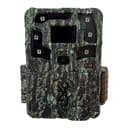
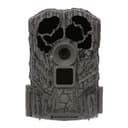
Trigger speed is the delay between the sensor detecting heat and motion and the shutter firing. On a trail where a deer walks past at a steady pace, a 0.2-second trigger photographs the animal and a 1-second trigger photographs where it was. Browning publishes 0.22 seconds for its Strike Force Pro X and a 0.35-second recovery time; the cellular picks here publish 0.3 to 0.5 seconds, which is fine on a trail you set the camera across rather than along.
The tell for a cheap camera is not a slow published figure — it is no published figure. Our budget pick does not state a trigger speed, and at that price that silence is usually the answer. Set those cameras perpendicular to the trail so a deer stays in frame longer, not down the trail where it crosses the detection zone in one step.
3. Detection range sets the spot, not the camera
A camera with 60 feet of detection is a trail camera: hang it fifteen yards off a trail or a scrape and it will do its job well. A camera with 100 feet of detection can watch a field corner or a food plot edge. Both are useful; using the first one as the second is the single most common reason a camera returns an empty card. Read the published number and pick the location to match it, rather than hanging the camera where you want pictures and hoping.
4. Low-glow versus no-glow
Infrared flashes come in two bands. The common one, around 850nm, produces a faint red glow at the lens when it fires — that is “low-glow.” The 940nm band is invisible to the human eye and is sold as “no-glow.” Whether deer care is genuinely argued among biologists, and anyone who tells you it is settled is selling something. What is not argued: people notice a camera that lights up, which matters on public ground where cameras disappear. The physics trade-off is real too — no-glow costs you night-image brightness and reach, because you are using light further from what the sensor sees best.
If you hunt pressured deer, or hang cameras anywhere a stranger might walk, pay for 940nm. If you run cameras on private ground you control, low-glow gives you better night images for less money.
5. Power is the spec that ends seasons
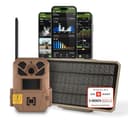
Battery life is where makers go quiet. Browning publishes up to a year on six AA cells; none of the cellular cameras here publishes a battery life figure at all, and that is not an accident — a cellular radio is the hungriest part of the camera, and cold weather makes it worse. Two practical rules follow. Use lithium AAs in anything you will not visit before December, because alkalines lose capacity fast below freezing. And on the camera you genuinely cannot approach, buy the solar version: a panel turns the battery from a reason to walk in into a non-issue, as long as the panel actually sees sky.
Where to hang it, if you are hunting from a blind
A camera set to find deer and a camera set to pick a blind site are not the same camera in the same place. For choosing where the blind goes, you want cameras on the routes, not the destination: a trail into a food source tells you which side deer enter from, which is the thing that decides which wall of the blind faces where. A camera on the food plot itself tells you deer eat, which you knew.
Hang it at deer-chest height, pointed slightly down, facing north or south so the rising and setting sun never stares into the lens. Clear the grass in front of it, because a moving stem triggers the sensor all night and fills the card. And set it on the same wind discipline you hunt — a camera you can only check by walking through a bedding area is a camera that costs you the stand. Our scouting guide covers reading the sign that tells you where to put the camera in the first place, and patterning a buck covers what to do with a month of photos once you have them.
One honest limit on all of it: a camera tells you what a deer did, in one spot, at one time. Daylight photos on a trail in late October are worth planning a sit around. A string of 2 a.m. photos is worth knowing about and not worth hunting. The hunters who get the most out of cameras are the ones who treat them as a tool for eliminating bad spots, which they are very good at, rather than as a promise about a specific deer.
Check your state’s rules before you hang anything
Trail camera legality is not settled national ground, and this is the one section of this page where getting it wrong carries a fine rather than an empty card. Several Western states restrict camera use for big game, and the restrictions are specific rather than general. Utah’s big-game rule defines a trail camera as any device not held or operated by a person that captures images, video or location data using heat or motion; prohibits placing or using one as restricted by state statute; and makes it unlawful to buy or sell trail-camera images, video or location data to take or help take big game.
Rules in the whitetail states are generally far looser, and many are about public land specifically — cameras on your own ground are rarely the issue. But “generally” is not a defense. Read your own state’s current regulations, and read them for the year you are hunting; this is an area agencies have been actively changing. A forum post from three seasons ago is not a source.
What we did not rank, and why
Several popular cellular cameras are missing from this list for one reason: their listings publish almost nothing measurable. No trigger speed, no detection range, no battery figure — just megapixels and a brand name. We rank on published specs and cannot rank what is not published, and we are not going to invent a number or imply we tested a camera we have never held. If a model you are considering is not here, check whether its maker publishes a real spec table. Often that answer is the review.