How to choose a box blind
Work through these in order. Each one eliminates options, and getting the order wrong is how people end up with a blind that is too small, on the wrong ground, with a tower bill they did not see coming.
1. Do you control the ground for the next five years?
This is the gate. A box blind is a structure: it needs a leveled, anchored site, it takes hours to assemble, and it is not coming with you if the lease changes hands. If you hunt public land, a one-year lease, or permission ground, buy a portable from our ground blind lineup instead and spend the difference on better placement. If you own or hold a long lease on the property, a box blind is probably the best money you will spend on it — it turns one good spot into a spot you can hunt in any weather, for a decade.
2. Blind only, or blind plus tower?
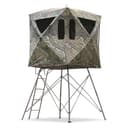
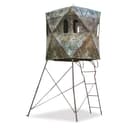
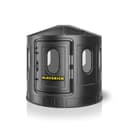
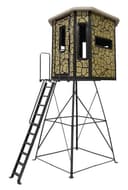
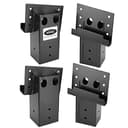
Read the listing twice on this one. Several of the best hard-sided blinds on the market — including two of the picks above — ship as the blind only. The tower is a separate purchase that can cost as much as the blind itself, and a mismatched platform is both a wasted weekend and a genuine fall hazard. Complete tower-blind packages cost more up front and save you that problem entirely; they are the right call for a first elevated blind. If you are buying blind-only, price the tower before you price the blind.
3. How much floor do you actually need?
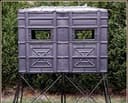
Floor area, not tower height, is what decides whether you sit still. The rule of thumb that holds up: a 4×4-foot box is one hunter in a chair with a gun. A 4×4 sold as “2-man” means two people physically fit, not that two people can sit there for six hours without bumping elbows and spooking deer. Going to a 6×6 or a 4×8 roughly doubles the usable space and is what makes mentoring a kid or running a camera realistic. If you only ever hunt alone, the smaller box is cheaper, lighter on the tower and easier to hide — take the win.
4. Windows decide the hunt
Inside a hard-sided blind, opening a window is the loudest and most visible thing you do. Sliding panelsyou can crack an inch at a time are a real, measurable upgrade over anything zippered or hinged that has to swing out. Count them and note where they are: windows on one long wall facing a field edge are worth more than the same number of windows spread over four walls looking into timber you will never shoot into. For gun and crossbow hunters, a horizontal slot at seated-rest height is ideal. For bowhunters, you need vertical windows and enough headroom to draw — which most 4×4 boxes do not have, and most listings do not state.
5. Material is a question about years, not looks
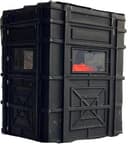
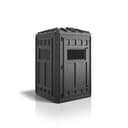
Fabric-on-frame tower blinds are the cheap way in, and the shell is the part that fails — sun and wind will get it in a handful of seasons, though replacement shells exist for the common platforms. Plywood and fiberglass boxes are the traditional middle: warm, quiet, and needing paint and a roof check every few years. HDPE panels do not rot, warp or need painting, and they deaden the sound of a boot or a rifle stock instead of broadcasting it. Steel is the buy-it-once answer and prices like it. There is no wrong choice here — there is only matching the material to how long you intend to hunt the spot.
What elevation actually buys you
Height is the one concealment variable money reliably improves. Getting six to ten feet up does two things: it lifts your scent cone so it drifts over a deer walking a trail at thirty yards instead of into its nose, and it takes your movement out of a deer’s direct line of sight. Both matter, and neither is magic. Thermals still pull your scent downhill in the evening and push it uphill in the morning regardless of how high you are, which is why reading thermals matters as much in a tower as on the ground, and why the best box blind on the wrong wind still gets you busted.
The flip side is worth saying plainly: a box blind is a large, angular, hard-edged object that appeared in a deer’s living room. Deer acclimate to it — far better than they acclimate to a pop-up, because it never moves and never flaps — but that takes weeks, not days. Set a new blind in the off-season, in late winter or spring, and let it become part of the scenery before the season you intend to hunt it. Tucking it against a treeline or fencerow and brushing in the base shortens that process considerably. And the usual placement rules apply unchanged: entry and exit routes you can walk without crossing bedding, a dark backdrop, and the sun behind you rather than in your windows.
Safety: the ladder, the heater and the law
An elevated blind is an elevated stand, and the fall statistics are the same. State wildlife agencies and the Tree Stand Safety Awareness Foundation report that the overwhelming majority of fall victims were not attached to anything when they fell. Use a full-body harness and a lifeline on the ladder, every climb, including the ones where you are just carrying up a chair. A tower blind feels like a building; the ladder is not a staircase.
Heat is the other one. A hard-sided blind is a sealed room, which is exactly why it is comfortable and exactly why carbon monoxide is a real danger rather than a theoretical one — the U.S. Consumer Product Safety Commission has documented CO deaths from portable propane heaters used in enclosed spaces. If you are running propane in a box blind, use a heater with a low-oxygen shutoff, crack a window on two walls, and read ground blind heater safety before the first cold sit. Our heater picks flag which units are rated for enclosed use and which are not.
Finally, check your own state’s rules before you build. Requirements vary a lot and they are specific: Wisconsin requires the owner’s DNR customer ID or name and address on an unoccupied blind on DNR-controlled land, and Minnesota law requires blaze orange on a fabric or synthetic ground blind used for deer on public land. Those rules are written around public ground and portable blinds, but the permanence of a box blind makes marking and identification requirements more likely to apply, not less. Read your regulations, not a forum post.
Who should skip a box blind entirely
If you move spots based on sign, hunt several properties, or do most of your killing by being in the right tree on the right wind this week, a permanent blind will make you a worse hunter by anchoring you to one place. Put the money into a mobile setup instead. If you need room for two but want to stay portable, the roomy 2-person pop-ups get you most of the comfort for a tenth of the cost. And if your problem is purely weather and cold rather than space, a good chair, a safe heater and better layers fix it far cheaper than a tower will.