Why coverage beats pattern against a turkey
Work through the NWTF’s figures and the shopping list writes itself. Vision three to four times more acute than yours means a turkey resolves detail at 40 yards that you would need binoculars to see. A roughly 270-degree field of view means there is no “behind” a turkey in any useful sense; you are in its vision almost all the time. Extremely rapid assimilation of detail means the thing that gets you is motion, not shape. And a color range that exceeds ours — probably into the ultraviolet — means your skin tone is a genuinely different color from the woods to an animal whose color discrimination beats yours.
Hands and faces are the only parts of you that are bare, bright and moving. That is why a $15 head net and a $25 pair of gloves outrank a $200 jacket in this category, and why the full-coverage head net is pick number two rather than an afterthought.
What to look for in a turkey head net
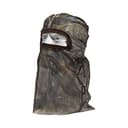
An open eye hole, not mesh over your eyes — you will be looking down a bead or through a scope in low light, and mesh in front of your pupil costs you more than it hides. The Allen Vanish Visa Form full head net publishes exactly that: an open, knit-trimmed eye hole and an adjustable nose bridge, so it sits off your eyelashes and stops the fabric tenting when you mount a gun. The 3/4 version in our head net rankings is the pick if you hate anything over your scalp.
What to look for in turkey gloves
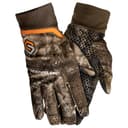
Thin enough to feel a safety and a trigger, long enough in the cuff that no wrist shows when you raise the gun, and fingertips covered. This is the one place our general glove rankings and this page disagree: fingerless gloves are excellent for deer-season dexterity and wrong for turkeys, because the bare fingertips are back on the list of bright moving objects. The ScentLok Savanna shooter glove is the pick here because it is a thin, high-dexterity glove rated for early-to-mid-season temperatures, which is spring turkey weather.
Pattern: what actually matters in spring
Pattern matters less than coverage and more than nothing. Two honest rules.
Match green-up, not deer season.Most hunters own late-autumn patterns — browns, greys, bare-branch prints — because that is what deer hunting demands. In a spring woods with leaves out and ground cover up, a greener pattern blends and a brown one reads as a stump. Mossy Oak Obsession, the pattern on our top pick, exists for precisely this season. Our pattern guide covers how the families differ, and how to choose camo for your terrain is the version of this argument for where you actually hunt.
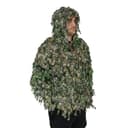
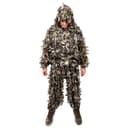
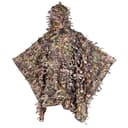
3D beats 2D when you are against a tree. A printed pattern flattens at distance; a leafy layer casts its own shadows and breaks the hard line of your shoulders and head, which is the shape a turkey is reading. This is the same mechanism we work through in ghillie suit vs leafy suit and how to break up your outline. For turkeys the leafy option also happens to be quieter and cooler than a full thread ghillie, which matters when you are hiking ridges in May.
One thing nobody has published: whether optical brighteners in laundry detergent make hunting clothes visible to a turkey. It is a popular claim and there is no study behind it. What ispublished is the NWTF’s statement that turkeys likely perceive ultraviolet, which makes brightener-free washing a cheap precaution rather than a proven edge. If you are already washing scent-free, you are most of the way there.
Blinds change the whole calculation
Hunt a turkey from a ground blind and the camo question mostly goes away. A hub blind with the windows set and the interior dark hides your hands, your face and your movement — which is exactly why it is the standard answer for taking a kid or a bowhunter after turkeys. The blind becomes the concealment and your clothing becomes comfort. Our turkey blind rankings and how to hunt turkeys from a ground blind cover that route, including the useful fact that turkeys tolerate a blind dropped in that morning in a way deer never will.
Buy this page’s gear if you run and gun, sit against trees, or hunt public ground where a blind is a liability to carry. Buy a blind if you sit still over a field and want a kid along.
Two things camo cannot fix
Movement.Given a turkey’s rapid detail assimilation and 270-degree field of view, the best pattern made is a bet you lose the moment you shift your weight. Pick your tree so that you can shoot where you expect the bird without repositioning, and read how to stay still while hunting before you spend on fabric.
Safety visibility.You are dressed, deliberately, as the thing other hunters are looking for. Many states regulate blaze orange for turkey hunters moving between setups, and the rules vary enough that no national answer exists — read your own regulations, flag your setup when you move, and never stalk a gobble. Our blaze orange picks cover what to carry for the walk in and out.