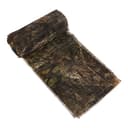
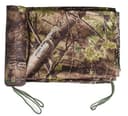
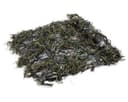
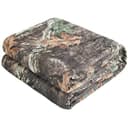
Three jobs, three different setups
Screening a natural or brush blind
Here netting is a frame for the real cover. Hang it across the open side, then weave in whatever is growing within a few yards — grass, cedar branches, cornstalks, briars. The burlap cradle mesh exists for this job because its rough texture grips vegetation instead of letting it slide out. The full build is in how to build a natural ground blind.
Covering a window you shoot through
This is the one that needs one-way see-through mesh rather than general netting. You want to watch an approach without a dark hole or a moving silhouette telling the deer where you are. Mount it so it is taut enough not to flap and loose enough not to hum in wind, and — this matters for bowhunters — test an arrow through it before you hunt, because “shoot-through” mesh and “see-through” mesh are not the same product.
Wrapping a tower or ladder stand rail
A hunter on an open platform is a shape against the sky. Netting around the rail cuts the lower half of that shape and hides your legs and hands, which is where most of your movement happens. Secure the bottom edge or the wind will make a flag of it; how to conceal in a tree stand covers the rest of that setup, including the backdrop problem netting cannot solve.
The mistake that gets hunters busted
Hanging netting flat and tight. A taut sheet of mesh in a wooded setting is a straight-edged rectangle, and a straight edge is exactly the kind of unnatural line that draws an animal’s attention. The peer-reviewed review of cervid visual ecology is the useful context: deer are dichromats with poor red and orange discrimination but eyes built for detecting motion in low light. They are not reading your pattern — they are reading shape and movement. So the netting needs irregular edges, slack to cast its own shadows, and vegetation threaded through it.
The second mistake is leaving the bottom hem free. Netting that lifts in wind is motion, in the one place you cannot see it happening. Stake it, weight it, or weave sticks through the bottom edge.
The third is hanging it where you will later need to move. Set the netting, then sit in your chair and run the whole motion — draw the bow, mount the gun, swing to the far window — before you ever hunt it. If any of that catches the mesh, fix it now rather than at first light.
How long will it last outside?
A lightweight mesh left up through a winter will fade and tear at its tie points; a heavy-duty netting is the one to pick for a blind you leave standing between hunts. The same arithmetic as a manufactured blind applies — UV is what kills it, not use — and we worked through that in how long ground blinds last. The cheap habit that doubles its life: take it down at the end of the season and store it dry, out of the sun.
Last thing. Set netting up early. A screen that appears the morning you hunt is a new object in a place deer walk daily; one that has been there three weeks is scenery. Netting is cheap enough to buy twice and hang in both of your spots in September, which is a better use of the money than upgrading the mesh.