What you actually give up at the bottom of the market
Budget blinds are not worse at hiding you. That is the surprising part, and it is why this category is worth taking seriously instead of treating a cheap blind as a compromise. What you give up is durability, silence and convenience— in that order.
Fabric and zippers, not concealment
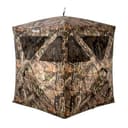
The thing that dies first on a cheap blind is the zipper, followed by the shell at the hub corners where it flexes every time you open it. Thinner fabric also means more light transmission, which matters more than it sounds: light coming through the back wall backlights you and turns every movement into a readable silhouette. The Barronett in this list publishes an HD 150-denier shell with a black interior coating, which is the single most useful spec on a budget blind, and most blinds in this price band do not publish it at all.
Noise is the real budget tax
A cheap window is a zip-and-rip velcro flap; an expensive window slides silently. You open windows at the worst possible moment — when something is already close — so this is a genuine concealment difference, not a luxury. The good news is that it is also the one budget weakness you can fix for a few dollars with the tricks in how to quiet a ground blind: open your windows at dark, lubricate the zippers, and never touch them again during the sit.
Weight goes up as price goes down, usually
The exception at the top of our list: the Care Taker and the Outhouse are both cheap and light, which is unusual. Past about $150 the cheap blinds get cheap by getting bigger and heavier rather than by cutting features. The Barronett is 15 lb packed. That is fine for a blind you drive to and leave, and wrong for a blind you carry a mile.
How to spend $100, $200 or $350
Under $100 — one hunter, one blind, done
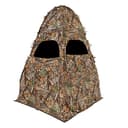
Buy the Care Taker. It is the honest default: hub setup, shoot-through mesh for a bow, packs small enough to live behind a truck seat. The Outhouse is the alternative if your priority is weight and pack size over interior room, and the two trade places on price regularly — whichever is cheaper the day you look is the right one.
Around $110 — buy visibility instead
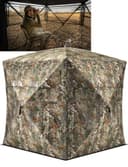
The TIDEWE 270° blind is the interesting pick in this band because it buys you a category feature, not a nicer version of the same thing. One-way see-through mesh across 270 degrees means you watch a deer or a turkey commit without opening a window. It is a lighter build than the premium see-through blinds and the mesh is dimmer in the first and last hour of light; we go through that trade in detail in are see-through ground blinds worth it.
Around $160 — buy room, plan to brush it in
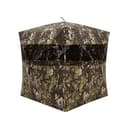
The Barronett Ace 250 is a 75-by-75-inch floor with 67 inches of height and a silent panoramic front window, and it includes detachable blaze-orange panels for firearm season — a legal requirement in several states that most makers leave you to solve yourself. The catch is physics: a bigger box is a bigger thing for a deer to notice. Barronett builds brush holders into the shell precisely because this blind needs them.
Around $325 — get off the ground
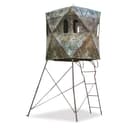
This is the price point most budget shoppers do not know exists. A 6-foot tripod tower blind with an enclosed 4-by-4-foot platform costs about what a premium pop-up costs, and elevation does something no pop-up can: it lifts your scent cone and your sightlines over the cover. If your ground is flat crop country, that is worth more than any fabric upgrade. The trade-offs are covered in ground blind vs box blind, and the full hard-sided lineup is in best box blinds.
The cheapest route of all
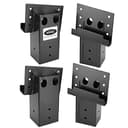
Four compound-angle elevator brackets and lumber from a yard is the lowest total cost to an elevated, hard-sided, permanent blind by a wide margin. You supply the 4x4 posts, the deck and the labour, and Mofeez does not publish a rated load — which is exactly why we list it last and tell you to build conservatively. It is the right answer for one specific buyer: someone with tools, a truck, private ground and a spot they are certain about.
Blaze orange is not optional, and the cheap blinds mostly ignore it
If you hunt public land in gun season, the blind itself may be regulated. Minnesota requires a fabric or synthetic ground blind used for deer on public land to carry a blaze-orange covering on top visible for 360 degrees orat least 144 square inches of blaze orange on each side. Wisconsin requires 144 square inches of solid blaze orange or fluorescent pink visible from all directions during firearm deer seasons on DNR-controlled land, plus the owner’s customer ID or name and address on an unoccupied blind — with an exemption for blinds built entirely of dead vegetation found on the property.
Budget this. The Barronett includes the panels; for everything else, a cheap orange vest draped over the top is the usual fix and our blaze orange pickscover what to buy. And check your own state’s regulations rather than a forum post — the rules vary enough that no national answer exists.
Where a cheap blind will genuinely cost you
Two situations where we would tell you to save longer instead of buying down.
You get busted repeatedly at the window. That is a visibility problem, and the fix is a see-through wall. The TIDEWE is the cheap version, but if you hunt open country and your sits keep ending the same way, the premium see-through blind in our main rankings fixes a cause rather than a symptom.
You are hunting two people, one of them new.A cramped blind with a bored kid in it is a failed hunt regardless of fabric quality. Buy the floor space — 2-person blinds and what size ground blind you need both work through the real numbers.
Everything else — placement, brushing in, wind, entry route, keeping still — is free, and it decides more hunts than the price of the blind ever will. If you buy at the bottom of this page and spend the saved money on nothing at all, you will still out-hunt most people with expensive blinds.