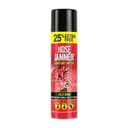
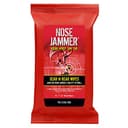
Honest answer: nobody can tell you Nose Jammer works, because no independent efficacy data has been published for it — or for any scent-control product you can buy. What we can do is separate the part that is verifiable from the part that is marketing, and tell you how to spend about $13 on it in a way that is at least sensible. If you want the one-line version: treat it as a boots-and-brush product, never spray it inside a closed blind, and do not buy it expecting it to replace hunting the wind.
Nose Jammer is interesting because it is the only mainstream product in this category attempting a genuinely different mechanism, and that deserves to be described accurately rather than mocked or oversold.
What Nose Jammer actually claims to do
Every other product in scent control is trying to subtract. Eliminators neutralise odor molecules; carbon garments adsorb them; ozone generators oxidise them; a cover scent masks them with something a deer expects. Nose Jammer is trying to add— to put so much aroma into the air around you that a deer’s olfactory system cannot resolve your human odor out of the noise. The listing describes it as a mask-and-overwhelm approach rather than an elimination one, and rates it for use on clothing, boots, tree stands and the surrounding brush.
That is a coherent theory. A whitetail’s nose is not a yes/no detector; it is a discrimination system, and discrimination can in principle be swamped. The National Deer Association’s work with University of Georgia researcher Dr. Gino D’Angelo on how deer use sight, hearing and smell describes an olfactory capability well beyond human experience — which is both the reason the overwhelm idea is attractive and the reason it is hard to believe a 6-ounce bottle achieves it.
What the listing does notpublish is the active formula. We show that field as “Not published” rather than describe a formulation we cannot verify. You are buying a described mechanism, not a disclosed one.
Why there is no straight answer — for any of these products
This is the context that matters more than anything specific to Nose Jammer. No scent-control product in this market publishes independent efficacy data. Not the sprays, not the soaps, not the detergents, not the ozone machines. We list “Independent efficacy data: Not published” as a spec row on every one of them in our registry, because the absence is the finding.
The closest thing the category has to real testing is at the carbon-clothing end. MeatEater’s reporting on scent-control efficacy, citing the ScentLok/Rutgers testing, lands on a conclusion worth memorising: carbon adsorbs a great deal of odor, and total scent elimination is not possible. If the best-funded, most-tested corner of the category cannot claim elimination, no $13 bottle of anything is going to beat a nose outright. That does not make the bottle useless — reducing or confusing your odor signature is a real goal — but it does set the ceiling on what you are buying.
We go through what that means product by product in does scent control work, and the honest budget version is in scent control on a budget.
The risk nobody mentions: adding a smell can go the wrong way
If the overwhelm mechanism does not work the way the marketing describes, you have not landed on neutral — you have added a strong, novel, non-local smell to a deer’s environment. A deer that notices an aroma that does not belong in a cut cornfield in November responds to it the same way it responds to any other thing that does not belong: by leaving, or by circling downwind to investigate, which is worse.
This is the same objection that applies to cover scents, and it is why we treat the two together in how to use a cover scent and best cover scents. The practical rule from both: if you are going to add a smell, add one that is plausible for where and when you are hunting, and apply it to your boots and the ground rather than to the air around your face.
What to look for before you buy anything in this category
Four questions, in order. They are the same four whether you are looking at Nose Jammer, a $40 eliminator or a $300 ozone bag.
1. Does the maker publish a mechanism or just a result?“ Eliminates odor” is a result. “Continues working after it dries” is closer to a mechanism. An undisclosed active formula is neither.
2. Does it publish where to use it? A product rated for clothing, boots, stands and brush is telling you something useful about how it is meant to work. A product with no stated application is just a bottle.
3. What does it cost per season, not per bottle? A 6 oz bottle at $13 and a 44 oz refill at a modest premium are wildly different per-season costs. A twenty-count wipe pack goes fast if you wipe down every sit.
4. Is it replacing wind discipline or supplementing it?If the honest answer is “replacing,” put the money back in your pocket.