Blind & Brush

Are See-Through Ground Blinds Worth It?

One-way mesh walls solve the biggest ground-blind problem — you cannot see game coming. Here is what you give up for it, and who should pay the premium.

By Stephen V.Last updated How we pick

How this is funded:we earn a commission if you buy through our links, at no extra cost to you. It never changes which product we recommend, and we’ll tell you plainly when we’d skip one. Full disclosure.

Yes — if the reason your blind hunts fail is that deer appear at the window before you are ready. No, if you hunt thick cover where everything shows up at twenty yards anyway. That is the whole answer. A see-through blind uses a one-way mesh wall so you can watch an animal approach from eighty yards without opening a window, which means you are already still, settled, and on the rest before it is in range. For a bowhunter or a crossbow hunter that is the difference between a shot and a staring contest.

What you pay for it is real: more money than a conventional hub, and a wall that is dimmer to look through in the first and last hour of light, which is exactly when deer move. Below is how the mechanism actually works, who should pay the premium, who should not, and the three blinds that bracket the decision.

How one-way mesh actually works

There is no clever coating doing the work. A see-through blind wall relies on a light differential: outside is bright, inside is dark, and a fine mesh viewed from the bright side reads as a solid surface while the same mesh viewed from the dark side is transparent. It is the same effect as a screen door on a sunny day.

Two consequences follow directly, and they are the whole fine print of this category.

The effect weakens as the light evens out.At dusk and dawn, when outside brightness falls toward the brightness inside the blind, the differential narrows. Makers acknowledge the mesh is dimmer to look through in low light than a solid open window, and that is honest. You still see out — just with less detail at the precise moment you most want it.

You must keep the interior dark. Any light inside the blind inverts the differential and turns your wall into a lit display. That means no phone screen, no white headlamp, and ideally a blind with a blackout interior coating. Our hunting light picks and red light vs green light cover how to see inside a blind without broadcasting it.

Why this solves the real ground-blind problem

The failure mode of ground-blind hunting is not that deer see the blind. It is that you cannot see them. From inside a conventional hub you are looking through two or three window-sized apertures at a fraction of the arc around you, which means the first time you know a deer is there is often when it is already at twenty yards, broadside, and looking at a dark rectangle. At that point every movement you need to make — lifting a bow, swinging a crossbow, opening a second window — is a movement a deer can catch.

Peer-reviewed work on cervid vision helps explain why this matters so much. Deer are dichromats, sensitive to short blue wavelengths and poor at the red and orange end of the spectrum, and the foundational cone-sensitivity measurements on whitetails put their peak sensitivities around 450-460 nm and roughly 537 nm. What that means practically is that deer are not reading the detail of your camo pattern — they are reading movement and outline against a background. A blind already defeats the outline. The thing that still gets you caught is the movement, and the only fix for that is knowing about the deer before it knows about you. That is precisely what a see-through wall sells.

The related point most hunters underrate: a see-through wall also lets you not move. You can skip opening an extra window, skip the slow lean to check the left trail, skip the repositioning. Those are the three things that get hunters busted, and they are covered in detail in how to hunt from a ground blind and how to stay still while hunting.

The blinds that do this, and the standard blind to compare against

A premium see-through front wall, the budget 270-degree version, and a conventional hub blind as the baseline so you can see what the premium actually costs. Prices are live — check the “as of” stamp under each button.

Quick picks

Ranked on published specs, concealment fit and value. Select a row to jump to the full write-up. We have not field-tested this gear — here is exactly what we do instead.

#ProductBest forPrice
1
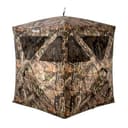
Primos Full Frontal See-Through Blind

Primos Full Frontal See-Through Blind

The one blind here that solves the biggest ground-blind problem — you can't see game approach. Its front wall is one-way see-through mesh: you watch deer come in without opening a window, and they see an opaque wall. If busted setups are your issue, this is the fix.

Best see-through blind
$288.99 · View on Amazon

Price as of October 4, 2026. #ad How we’re funded

2
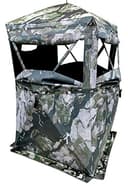
TIDEWE 270° See-Through Hunting Blind

TIDEWE 270° See-Through Hunting Blind

The budget way to get see-through walls. It borrows the one-way-mesh idea from far pricier blinds so you can watch turkeys and deer approach through 270 degrees, at a fraction of the premium cost. The value pick for situational awareness.

Best budget see-through
$109.99 · View on Amazon

Price as of October 4, 2026. #ad How we’re funded

3
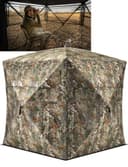
Ameristep Care Taker Ground Blind

Ameristep Care Taker Ground Blind

The blind most hunters should buy first: a genuine hub blind that sets up in seconds, packs small, and costs about a third of the premium names. It is the honest default for a beginner or a run-and-gun setup, and the reason it tops this list is value, not luxury.

The conventional baseline
#1Best see-through blindSee-through hub blind

Primos Full Frontal See-Through Blind

The one blind here that solves the biggest ground-blind problem — you can't see game approach. Its front wall is one-way see-through mesh: you watch deer come in without opening a window, and they see an opaque wall. If busted setups are your issue, this is the fix.

Strengths

  • One-way see-through mesh front — a huge situational-awareness gain
  • Silent-slide windows adjust without the zip-and-rip noise of a cheap blind
  • Brush straps along the window ridges let you blend it into native cover

Trade-offs

  • Costs more than a standard hub blind
  • The see-through mesh is the front wall, not all four — it is not a 360-degree view
TypeHub-style with one-way see-through front
One-way see-through meshYes (front wall)
WindowsFully adjustable silent-slide
CamoVeil
CapacityNot published

The spec that matters. See-through walls are the feature that actually changes your hunt. You detect deer at 80 yards instead of at the window, which means you're already still and drawn before they're in range.

Specs read from the product listing, on August 26, 2026. “Not published” means the maker does not state that figure.

#2Best budget see-throughSee-through hub blind

TIDEWE 270° See-Through Hunting Blind

The budget way to get see-through walls. It borrows the one-way-mesh idea from far pricier blinds so you can watch turkeys and deer approach through 270 degrees, at a fraction of the premium cost. The value pick for situational awareness.

Strengths

  • 270° one-way see-through mesh for early game detection
  • Comes with a carry bag and stakes at a low price
  • Popular for spring turkey where you need to track birds

Trade-offs

  • Lighter build than the premium see-through blinds
  • See-through mesh is dimmer in low light than solid windows
TypeHub-style with 270° see-through mesh
One-way see-through wallsYes (270°)
Capacity1-2 hunters
IncludedCarry bag + stakes
Packed weightNot published

The spec that matters. See-through mesh trades a little brightness for a lot of awareness. In the low light of the first and last hour it's dimmer than a clear window — a fair trade for seeing a bird commit before it's in your lap.

Specs read from the product listing, on July 22, 2026. “Not published” means the maker does not state that figure.

#3The conventional baselineHub ground blind

Ameristep Care Taker Ground Blind

The blind most hunters should buy first: a genuine hub blind that sets up in seconds, packs small, and costs about a third of the premium names. It is the honest default for a beginner or a run-and-gun setup, and the reason it tops this list is value, not luxury.

Strengths

  • Hub design snaps open and shut in seconds with no pole threading
  • Packs to a compact carry disc that fits behind a truck seat
  • Durametric shell and shoot-through mesh windows at an entry price

Trade-offs

  • Tight for two hunters — it is really a solo or archery-first blind
  • Lighter fabric than the premium blinds; treat the zippers gently in cold
TypeHub-style pop-up
Capacity1 hunter (roomy) / 2 tight
Shoot-through mesh windowsYes
Blackout interiorNot published
Packed weightNot published

The spec that matters. The spec that decides a blind is the WINDOW layout, not the brand. The Care Taker's shoot-through mesh lets you draw a bow behind cover; that matters more for concealment than a few extra denier of fabric.

Specs read from the product listing, on July 22, 2026. “Not published” means the maker does not state that figure.

Who should buy one

Bowhunters.The strongest case. A bow shot requires you to draw before the deer is in range and alert, and you cannot do that if the first you know of the animal is a shape at the window. Everything about a bow hunt from a blind gets easier when you have thirty seconds of warning — which is also why shooting a bow from a ground blind spends so much time on the sequence of movements before the shot.

Open-country and field-edge hunters. If deer appear at 150 yards and work their way in across a cut cornfield or along a fence line, a see-through wall turns the whole approach into usable information: which trail they are on, how many, whether the buck is in the back. That is worth substantially more than it is in thick timber. See hunting a cut cornfield, hunting field edges and hunting a fence line for the setups where this pays best.

Turkey hunters.Birds circle, hang up and commit from unexpected angles, and tracking a gobbler through a 270-degree mesh wall rather than three small windows is a genuine advantage. It is a large part of why the budget 270-degree blinds are popular in spring — hunting turkeys from a ground blind covers the rest of it.

Hunters who keep getting busted.If your honest diagnosis is that deer catch you moving at the window, this fixes the cause rather than the symptom. The alternative diagnosis — that they smell you — is not fixed by any wall, and the money belongs in scent control in a ground blind instead. Work out which it is before you spend.

Who should not

Tight-cover hunters.In a creek bottom, a thick funnel or a brushy pinch point, deer appear at twenty yards whether you can see out or not. You are paying a premium for range you do not have. Put the money into placement and brushing in instead — funnels and pinch points and creek bottoms both reward position over equipment.

Hunters who move blinds constantly.The premium see-through blinds are heavier and more expensive, which makes them worse candidates for a blind you carry deep and relocate weekly. A light conventional hub you actually move to the right spot out-hunts a better blind in the wrong place — the whole argument of where to place a ground blind.

Anyone whose blind problem is noise. If deer blow at your blind before they ever see it, you have a zipper, chair or fabric problem. Quieting a ground blind is cheap and fixes more hunts than a wall upgrade.

What a see-through blind does not change

Your scent. A blind concentrates your odor and releases it through the windows in a plume, and a mesh wall makes no difference to that at all. Wind direction and entry route still decide most hunts. If you want one page on this, it is scent control vs hunting the wind.

Acclimation.A blind is a new object in a deer’s living room, and they treat it with suspicion for days or weeks regardless of what the walls are made of. Setting it early and brushing it in does more for your odds than the window technology. The mistakes that undo this are catalogued in ground blind hunting mistakes.

Your legal obligations.See-through walls are still fabric or synthetic, so the blind rules apply unchanged. Minnesota law requires a fabric or synthetic ground blind used for deer on public land to carry blaze orange visible for 360 degrees on top, or at least 144 square inches on each side. Wisconsin requires 144 square inches of solid blaze orange or fluorescent pink visible from all directions on DNR-controlled land during firearm deer seasons, plus the owner’s identification on an unoccupied blind. Check your own state’s regulations rather than a forum post.

Where the deer are.The best blind in the world on the wrong trail is a tent. Seeing further is only valuable if there is something to see, which is a scouting problem — e-scouting and patterning a buck are free and they decide more hunts than any purchase on this page.

The verdict in one line

A see-through blind buys you time, and time is the scarcest resource in a ground-blind hunt. If you bowhunt, hunt open country, chase turkeys, or keep getting caught mid-movement, the premium is justified and the budget 270-degree option makes it affordable. If you hunt thick cover, move your blind constantly, or your real problem is scent or noise, spend the money somewhere it will actually change the outcome. Either way, the full blind lineup — see-through and conventional — is ranked in best ground blinds, and how to choose a ground blind works through the rest of the specs.
Frequently asked questions

Are see-through ground blinds worth the money?

They are worth it if you get busted or caught unprepared — which is the most common way a ground blind hunt fails. A one-way mesh wall lets you watch deer approach from eighty yards without opening a window, so you are already still, settled and on the rest before the animal is in range. They are not worth it if you hunt a tight funnel where game appears at twenty yards regardless, or if your blind problem is scent rather than sightlines.

Can deer see through see-through blind walls?

Not in the way you can. The mesh works on a light differential: the outside is bright and the inside is dark, so from outside the wall reads as opaque while from inside you see out. That is also the mechanism's limit — the effect weakens as outside light drops at dusk and dawn, and it can fail outright if you run a light inside the blind. Keep the interior dark and you keep the effect.

Do see-through blinds work in low light?

Less well, and makers say so. The mesh is dimmer to look through than a clear open window, which costs you a little detail in exactly the first and last hour when deer move most. The honest trade is that you lose some brightness and gain a lot of early warning. In practice most hunters find the warning worth more, because seeing a deer at range matters more than seeing it in perfect detail at twenty yards.

Is a see-through blind good for bow hunting?

Yes, and it is arguably the strongest case for one. A bowhunter needs to draw before the animal is in range and alert, and that is only possible if you saw it coming. A see-through front wall buys exactly that time. Just confirm whether the blind's shoot-through mesh is rated for broadheads, and remember the see-through panel is a wall you look through, not a panel you shoot through.

What is the difference between see-through mesh and shoot-through mesh?

They are different materials doing different jobs. See-through mesh is a one-way wall panel that lets you watch game approach; it is not designed to be shot through. Shoot-through mesh covers a window and is designed to let a broadhead pass without deflecting — commonly rated for broadheads only, not crossbow bolts. Confirm which is which on any blind you buy, because the names are easy to confuse and the consequence of getting it wrong is a deflected arrow.

Sources

Keep reading