What $200 actually buys, and what it does not
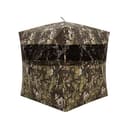
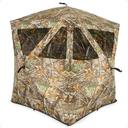
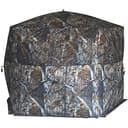
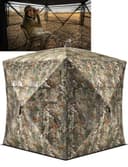
Every blind on this page is a fabric pop-up with a hub or spring-steel frame, shoot-through or sliding windows, and a camo shell with a dark interior coating. That is the whole architecture of the category, and it does not change above the cap. What does change, in order of how much it affects a hunt:
- Floor area. The spread here is the widest of any spec: 50 x 50 in. on the cheapest pick against 95 x 95 in. on the four-person lodge. Floor is what lets you turn, draw, move a chair, or sit a second hunter without elbowing them. It is the single best use of the money.
- Standing height. Sixty inches versus 71 inches is the difference between sitting to shoot and being able to stand up. For a bowhunter it is close to decisive; for a gun hunter in a chair it matters much less.
- Window operation.“Silent sliding” and “silent toggle” windows are published on most of these; a cheap zippered window is the loudest thing in a blind at the worst possible second. All six picks here publish something better than a bare zip.
- Fabric and frame. The Barronett publishes 150 denier; the SPUR Collector publishes 210D polyester with a fiberglass frame. Denier is durability over seasons, not concealment. Frame material is what actually fails: fiberglass hubs crack in cold and wind where spring steel bends.
What $200 does notbuy is a hard-sided or elevated blind. Those start several times higher and solve a different problem — permanence, weather and height rather than portability. If that is the direction you are heading, read best box blind for the money instead, and ground blind vs box blind to decide which you actually need.
The published gap this price band shares
Three of these six blinds publish no packed weight at all. The two that do (15 lb on the Barronett, 10.6 lb on the SPUR Collector, with 13.5 lb on the Care Taker and 12.9 lb on the chair blind) make the comparison obvious; the four-person lodge publishes nothing, which for the largest blind here is the figure you most want before you agree to carry it anywhere.
Window counts and window dimensions are similarly patchy. The Ameristep Tent Chair Blind publishes no window data whatsoever, so there is no way to judge its sightlines before it arrives. We have listed that as a con rather than guessed a number, which is the policy across this site: a spec the maker does not publish renders as “Not published,” because that absence is itself a finding.
The useful consequence: in this band, buy on the specs that arepublished — footprint, height, frame, fabric, weight — and treat everything else as unknown until the blind is in front of you.
Which of these six is yours
If you shoot a bow
Height and shoot-through mesh decide it. The Care Taker publishes shoot-through mesh windows on its own listing, which is what lets you draw behind cover rather than through an open hole that leaks scent and telegraphs movement. Avoid the 60-inch blind if you intend to draw standing. The full argument, including seat height and the arc you can actually cover, is in best ground blind for bow hunting, and the shooting mechanics are in how to shoot a bow from a ground blind.
If you shoot a rifle or a shotgun
Shoot-through mesh is irrelevant to you — a firearm shoots an open window, and the Barronett’s own listing is explicit that its mesh is rated for broadheads only. What matters is sill height against your rest, a window wide enough to swing, and silence. The Barronett’s panoramic front window and the lodge’s full-panel sliders are the two best answers here. One legal note that catches blind hunters out: several states regulate blaze orange on the blindduring firearm seasons. Minnesota law requires a fabric or synthetic ground blind used for deer on public land to carry blaze orange on top visible for 360 degrees, or at least 144 square inches of blaze orange on each side; Wisconsin DNR requires 144 square inches of solid blaze orange or fluorescent pink visible from all directions during firearm deer seasons on DNR-controlled land. That is exactly why the Barronett’s detachable panels are worth something. Check your own regulation before gun season. More in best ground blinds for rifle hunting.
If you are walking in
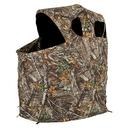
Weight and setup time are the only specs that count. The SPUR Collector at a published 10.6 lb and under two minutes, or the Tent Chair Blind at 12.9 lb with a published 30-second setup and no chair to carry separately. Both are honest one-hunter blinds; neither will let you stand.
If two of you are sitting all day
The Gobbler Lodge, at 95 x 95 in. and 71 inches tall with a blacked-out interior. It is the only blind here two adults can share without negotiating. Pair it with a real chair rather than a bucket — see best ground blind chairs — because the blind is not the thing that ends an all-day sit.
If you keep getting busted
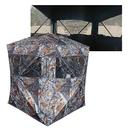
The TIDEWE’s 270-degree one-way mesh is the cheapest route to seeing deer commit before they are in your lap, which is the real cause of most blown ground-blind sits. It is dimmer than a solid window in the first and last hour, which is a fair trade. Whether it is the right trade is argued out in are see-through ground blinds worth it.
The $35 that matters more than the last $50 of blind
A cheap blind that is brushed in outperforms an expensive blind sitting naked in a field. Deer notice a new dark box; they do not notice a lump of brush. Spend the difference between the cheapest and the dearest pick here on the things that make any of them work:
- Brush it in. Every blind here has brush loops or holders. Use native material from off to the side, not from the shooting lanes. Method in how to brush in a ground blind.
- Stake it down properly. A pop-up blind in wind is a kite with you inside it. See best ground blind stakes.
- Kill the floor noise. Bare ground and dry leaves inside a blind undo a silent window instantly. Options in best ground blind flooring.
- Set it early. Deer forgive new objects given weeks rather than days. The full placement and timing logic is in how to set up a ground blind.
- Close the windows you are not using. Backlight through a rear window turns every movement inside into a readable silhouette, which is exactly what the dark interior coatings on these blinds are there to prevent.
What we left out, and why
Anything over $200 at the last refresh. This is a price-band page, so the band is enforced from the live price layer. The Primos Full Frontal see-through blind, which is the better version of what the TIDEWE does cheaply, sits above the cap and is ranked in best see-through ground blinds instead.
Blinds without a live offer.One of the registry’s own Ameristep listings came back with no offer at all on the day this page was written and was re-pointed to a verified-live listing before any of this was published. A dead listing is worse than no recommendation.
Thin stock. One sub-$200 Ameristep hub we track was down to a single unit, which is not a recommendation we can stand behind for a week, let alone a season. It is still covered in best budget ground blinds, which sorts the whole category on value rather than enforcing a cap.
Chair blinds as a general recommendation. The Tent Chair Blind is here as a specialist answer for a mobile gun or crossbow hunter. It is not the blind to own if you only own one.
DIY. A natural blind built from what grows on site costs nothing and conceals better than anything on this page. It also cannot be moved, takes an afternoon, and gives you no roof. If that is the trade you want, read how to build a natural ground blind.