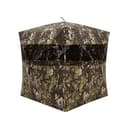
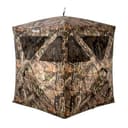
A pop-up ground blind that you take down and store between hunts will usually give you many seasons. The same blind left standing year-round often dies within one or two. That gap is the whole answer, and almost none of it is about which blind you bought. Exposure does the damage: wind tumbles an under-staked blind and splits the hub corners, UV quietly weakens the fabric until a normal gust tears it, and standing water rots the floor and the lower panels.
So the useful version of this question is not “how many years do I get” — it is “which three things am I doing that are shortening it, and what do they cost to fix?” Below: what actually kills blinds, how long you can leave one out (including the legal part, which catches people out on public land), how long deer take to accept it, and when to repair instead of replace.
What kills a ground blind, in order
1. Wind, and it is not close
An under-staked blind is a kite with a bag over it. The failure is rarely dramatic on the day — it is a season of flexing at the hub corners and the window edges, which is where every torn blind you have ever seen tore. Then one gust finishes it.
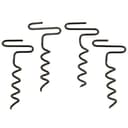
Straight spike stakes pull out of soft ground, which is exactly the ground that gets wet and loosens. An auger stake resists pull-out far better because it has to be unscrewed rather than lifted, and it is a ten-dollar purchase against a hundred-dollar blind. This is the single highest-return thing on this page. Our blind stake picks rank the whole category by soil type.
2. Zippers, forced in the cold with grit in them
A blind zipper fails for mechanical reasons you can prevent: dirt in the teeth, fabric bunched into the track, and being yanked at 20 degrees when it does not want to move. Brush the teeth out at the end of a season, do not force a cold zipper, and open your windows before legal light rather than when a deer is already there — which also happens to be the right thing to do for keeping a blind quiet.
3. UV, the slow one nobody notices
Sunlight breaks down the polyester and the coatings. You cannot see it happening; you see the result, which is a blind that has gone pale and then splits along a panel. A blind stored in a shed between hunts barely ages. A blind standing in an open field from August to January ages fast, and a blind left up all year ages faster than that.
4. Water, from below
The floor and the bottom few inches of the walls take the worst of it. A blind pitched in a low spot sits in standing water after every rain, which rots the floor seams and makes the whole blind smell — a scent problem on top of a durability one. A floor mat solves the abrasion and damp half of this for less than the price of one bad decision, and it also deadens footstep noise; blind flooring has the full lineup.
The fabric spec to look for — and the one almost nobody publishes
If you want to buy durability rather than manage it, there is exactly one spec worth hunting for on a product page: denier, ideally with the interior coating stated alongside it. Denier is the thread weight of the shell; a published figure means the maker is willing to be held to the fabric they used.
In our own registry, this is the exception rather than the rule. Most blinds leave fabric, packed weight and interior coating unstated, and we render those as “Not published” rather than estimate them, because a guessed denier is worse than an honest blank. The Barronett Ace 250 publishes an HD 150-denier shell with a black interior coating, and that combination — a stated fabric weight plus a coating that also kills the backlight that silhouettes your movement — is what a durability-first buyer should be looking for.
The other honest option is the opposite strategy: buy cheap, hunt hard, replace. A sub-$90 hub blind replaced every three seasons costs less than one premium blind and you always have current fabric. Which of the two you should do is mostly a question of whether you move your blind, and how to choose a ground blind works through it.