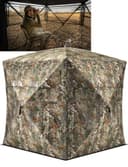
What a crossbow actually needs from a blind
Four specs decide this, and only two of them are on most product pages.
1. Floor width, not floor area
A crossbow is wide at the limbs and long front to back, and you shoot it seated with the forend supported. What you need is lateral room to rotate the whole weapon as a deer moves, which is a function of the blind’s narrowest dimension at seat height rather than its advertised square footage or its “person” rating. A blind sold as 2-person with a 60-inch wall will physically hold two hunters and will not let either of them swing a crossbow. The 75-inch and 95-inch footprints in this list are what the category actually wants.
2. A long horizontal window
Crossbow and gun hunters want the same thing here and bowhunters want the opposite: a wide horizontal opening at seated-rest height, ideally one continuous panoramic pane rather than three small separate ones. A continuous window lets you track an animal from first sighting to the shot without opening a second panel mid-stalk — which is the loudest, most visible thing you can do inside a blind. Both the Ace 250 and the THUNDERBAY Gobbler Lodge publish silent, repositionable full-panel windows; the Primos adds silent-slide panes you can crack an inch at a time.
3. Interior darkness
Because you are shooting through an open window rather than mesh, your silhouette is genuinely exposed, and a backlit interior turns every movement into a readable shape from the field edge. A blackout or black-coated interior is therefore a higher priority for a crossbow hunter than for an archer behind shoot-through mesh. The Gobbler Lodge publishes a black PU-coated interior and the Ace 250 a black interior coating; where a listing does not state it, our spec tables say “Not published,” which is its own kind of answer. Managing the rest of that problem — which windows you open, how many, and what is behind you — is covered in how to hunt from a ground blind.
4. Whether the mesh takes a bolt
Check the listing, every time. Shoot-through mesh is commonly rated for broadheads and commonly not rated for crossbow bolts, which travel faster and carry different mechanical heads. Shooting mesh that is not rated for your setup risks a deflection, a destroyed mesh panel and a wounded animal. Assume open-window shooting unless the maker says otherwise in writing. The full technique for that — rest position, clearance, the limb-strike risk at the window frame — is in how to shoot a crossbow from a ground blind, which is worth reading before your first sit regardless of which blind you buy.
Why each pick is here
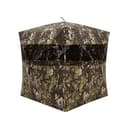
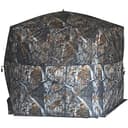
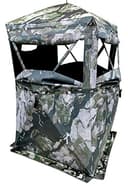
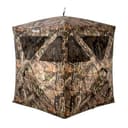
Barronett Ace 250 — best overall. 75 by 75 inches of floor, 67 inches of height, a silent adjustable panoramic front window and 150-denier fabric with a black interior coating. That combination is exactly what a crossbow wants, and the included detachable blaze-orange panels solve a legal requirement several states impose. The costs are honest: 15 lb packed is not a walk-in-deep blind, and the shoot-through mesh is broadhead-rated only.
THUNDERBAY Gobbler Lodge — best for two. 95 by 95 inches hub to hub with a 71-inch center height, a black PU-coated interior and noise-free full-panel sliding windows. If you are mentoring a young hunter, running a camera, or simply want to swing a crossbow without thinking about it, this is the most room per dollar in the list. It is large and it is a drive-to-the-spot blind, not a mobile one.
Primos Full Frontal — best for seeing game approach. The one-way see-through front wall solves the crossbow hunter’s other problem: a cocked crossbow is slow to reposition, so you need to see a deer at eighty yards and be settled before it is at thirty. Silent-slide windows and brush straps round it out. It costs more than a standard hub, and the see-through section is the front wall only — not a 360-degree view. We go deeper on whether that trade is worth it in are see-through ground blinds worth it.
Ameristep Care Taker — best budget.A genuine hub blind at roughly a third of premium money, which sets up in seconds and packs to a disc. The caveat is the one that matters for this page: it is roomy for one and tight for two, so it is the solo crossbow hunter’s budget pick rather than a shared blind. Ameristep does not publish a blackout interior spec on the listing we read.
TIDEWE 270° — best cheap see-through. It borrows the one-way mesh idea at a fraction of premium cost, over 270 degrees rather than one wall, which is genuinely useful for tracking turkeys and deer circling a setup. The build is lighter and the mesh is dimmer in the first and last hour of light. For a crossbow hunter on a budget who keeps getting caught flat-footed, it is a reasonable trade.
The setup side of crossbow blind hunting
A crossbow in a blind rewards preparation more than most setups, because you cannot reposition quickly once a deer is close. Three things pay for themselves immediately.
A rest.A crossbow is front-heavy and holding it on target freehand for even thirty seconds is a losing game. A tripod, monopod or window-height rest turns a marginal shot into a steady one — our shooting stick and tripod picks cover the options, and bipod vs tripod covers the choice.
Chair height, set once. Your seat height determines whether the window is at rest height, and a chair an inch too low makes a good blind useless. Set it at home with the crossbow, not in the dark on opening morning. The blind chair picks and the common ground blind mistakes both cover why this is the single most-skipped step.
Brushing in, and the legal check. A blind set in the open is an object deer learn to avoid; one tucked into a treeline and brushed in becomes scenery. Our guide to brushing in a ground blind covers the technique and where to place a ground blindcovers the siting. Then check your own regulations: Minnesota law requires a fabric or synthetic ground blind used for deer on public land to carry blaze orange visible for 360 degrees on top, or at least 144 square inches on each side, and Wisconsin requires 144 square inches visible from all directions on DNR-controlled land during firearm deer seasons plus owner identification on an unoccupied blind. Rules vary by state and they are specific — read yours.
If you are new to this entirely, the broader orientation is in deer hunting for beginners, and crossbow vs compound bow for blind hunting covers the choice of weapon before the choice of blind. A blind also works for turkeys from a ground blind, where a crossbow is an increasingly common and very effective choice.