What “for the money” means in this category
It does not mean the cheapest sticker. A box blind is bought once and sat in for ten or fifteen seasons, so the honest metric is cost per square foot of usable floor, and after that cost per hunter it seats. Run those two numbers and the ranking stops matching the price order.
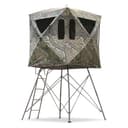
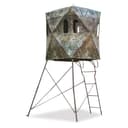
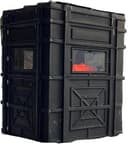
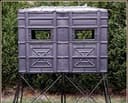
The quad pod publishes a 6x6 platform — 36 square feet with the tower included. The tripod publishes 4x4, so 16 square feet, at under half the price: a slightly worse rate per square foot but the lowest total cost of any complete unit here. The 4x4 hard-sided Enforcer gives you the same 16 square feet as the tripod for a good deal more money andno tower — which only makes sense if what you want is insulation, security and a twenty-year shell rather than floor area. The 4x8 Clubhouse doubles the floor of the Enforcer for roughly 40% more at the last price refresh, which is the best rate per square foot of any ready-made blind on this page, and the right answer if two people or a kid and a camera are going in it.
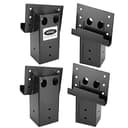
And the brackets win outright on rate, because you are buying four pieces of steel and supplying the rest. If your time and a truck are cheaper than money, that is the best deal in elevated hunting.
The two specs nobody in this category publishes
Both matter, and across all five picks above they are blank:
- Interior standing height. Not published on a single one of them. This decides whether a gun hunter can stand to shoot, whether a bowhunter can draw at all, and whether a six-foot-two adult spends five hours with their head tilted. It is the most important dimension in a box blind and it is the one you cannot look up.
- Shipping weight. Also unpublished. For a hard-sided box with no tower, this is the difference between a two-person afternoon and a tractor with a loader. Ask the seller before you order a hard-sided blind.
Where a figure is not published, the spec tables above say “Not published.” On a purchase this size, call and ask — and treat an unanswerable question about standing height as information in itself.
Fabric tower blind or hard-sided box?
This is the real decision, and price alone will not settle it.
A fabric tower blind (the two Guide Gear picks) gets you elevated immediately, with the tower in the box, for the least money. The shell is a tent on legs: it will need the fabric treated, the zippers minded and, eventually, replacing. It is the right call for a spot you may want to move, or a lease you do not own.
A hard-sided box (the two Hughes picks) is a structure. It holds heat, keeps rodents out of the cushions, takes a real door and a lock, muffles sound far better and lasts decades. It costs more up front, needs a tower you buy or build, and once it is up it is not moving. The spot has to be right. The full comparison, including what each type does to your scent profile, is in ground blind vs box blind.
If what you actually want is the cheapest way to hunt concealed at ground level, this is the wrong page — read best budget ground blinds, which ranks the fabric hub blinds on price and starts an order of magnitude lower.
The costs that are not on the price tag
- The tower, for any hard-sided blind. Posts, brackets, bracing, decking and stairs. Budget for it as a second purchase, not a rounding error.
- Getting it there. A hard-sided 4x8 does not go in a pickup bed whole. Access matters as much as the blind.
- Anchoring. An elevated blind is a sail. Guy wires or ground anchors on all four corners, inspected annually.
- The chair, the mat and the heater. A box blind with a folding camp chair and a bare plywood floor is a cold, noisy box. Budget for a swivel chair, flooring and a heater. If you run propane in an enclosed box, read ground blind heater safety first — CPSC testing of portable propane radiant heaters measured carbon monoxide accumulation in enclosed spaces, and a sealed box blind is more enclosed than a fabric one.
- A safe way up and down. An elevated blind is a tree-stand-height fall risk with a ladder attached. Wisconsin DNR and the Tree Stand Safety Awareness Foundation both centre their guidance on staying connected during climbs and transitions, and a blind door at the top of a stairway is a transition.
Rules worth checking before you build
Permanent and semi-permanent blinds are regulated differently from pop-ups. On DNR-controlled land in Wisconsin, for example, blinds left unattended carry identification and placement requirements, and several states require blaze orange to be visible on or around a ground blind during firearm seasons — Minnesota statute 97B.071 sets out such a requirement. Public land often prohibits permanent structures entirely. If you hunt a lease, get the landowner’s position in writing before you sink four posts.
What we did not include, and why
The premium buy-it-once towers. A fully-outfitted box blind on a 10-foot elevated tower is a genuinely excellent product and the opposite of a value pick; it is in best box blinds with the rest of the category ranked on specs rather than price.
A hard-sided blind with no live offer. One four-panel model in our registry currently shows no purchasable offer, so it is not ranked here. We do not put a price-value argument on a product you cannot buy today.
Build-cost estimates for the DIY route. Lumber prices move weekly and vary by region, so any total we printed would be wrong by the time you read it. The brackets are priced above; price your own posts locally.
Durability claims we cannot source.We own none of these blinds, so there is no “lasted us five seasons” anywhere on this page. What there is instead is the published spec, the unpublished gaps named plainly, and the arithmetic you can check yourself.