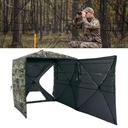
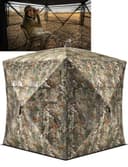
How we ranked these, and the four specs that decide it
Every blind here is a fabric hub blind with one-way mesh somewhere in its walls. What separates them, in the order it affects a hunt:
- Coverage you can control. More degrees of mesh is not automatically better, because the mesh needs a darker interior to work. A blind with a detachable blackout panel gives you both options from one purchase; a fixed 360 gives you one. This is the single biggest difference on the page and only the two TIDEWE 360 blinds publish it.
- Window geometry, not window count.Ten windows at chest height in a chair are worse than four you can shoot through sitting down. The five-sided TIDEWE is the only blind here that publishes a geometry change for this — a low-hub frame whose openings extend below the hub line — and that is a real engineering answer rather than a feature bullet.
- Whether it can be brushed in. A see-through shell gives a deer more surface to read, not less, and nothing about the mesh helps with that. Published exterior brush-in loops are therefore worth more on this page than on any other blind page we run. The Mossy Oak, the Primos and the TIDEWE 270 all publish them.
- Frame and anchoring.Pole diameter is the only durability figure anybody in this category publishes: 10 mm on the TIDEWE blinds, 9.5 mm on the FLISSA. None of it is spring steel. What is in the box matters as much — the FLISSA publishes four guy ropes and eight stakes, which is the difference between a blind and a kite.
The published gap: nobody will tell you what the mesh costs you
Here is the figure that decides whether a see-through blind is right for you, and not one maker in this category publishes it: how much light the mesh takes away. No light-transmission percentage, no mesh density, no stop value, nothing. Every listing sells the view out and says nothing about the two twenty-minute windows at each end of the day when the view out is the only thing that matters.
What they do publish is the fabric and the mechanism, and that at least tells you the shape of the trade. TIDEWE publishes its see-through as fabric perforation— the wall is a solid shell with holes in it, which is why the same panel can be covered by a 300D blackout layer. FLISSA publishes “high-density one-way mesh,” Mossy Oak publishes “one-way see-through mesh panels,” and Primos publishes a one-way mesh front. Those are descriptions, not measurements. Treat all of them as dimmer than a solid open window at first and last light, assume the dimming is real, and plan your legal-light window around it.
A second blank worth naming: not one see-through panel on this page is published as shoot-through. Mesh you can see through is not mesh you can shoot through, and the two are manufactured for different jobs. You shoot an open window out of a see-through blind, every time, with every weapon. The blinds in this registry that publish shoot-through mesh are solid-walled hub blinds — the Ameristep Care Taker and the Barronett Ace 250 — and that is a different purchase, covered in best ground blind for bow hunting.
270 or 360: it is a concealment decision, not an upgrade
The autocomplete suggestions for this category are dominated by “360,” and the market has responded by making 360 the default. Work through what the extra 90 degrees actually does.
With 270 degrees of mesh you have one solid wall. Put it at your back and three things happen: your silhouette has something dark behind it, the light gradient that makes the other three walls one-way is at its strongest, and the arc you cannot see is the arc you are not watching anyway because you chose it. The cost is that a deer can walk into that blind spot and be at thirty yards before you know.
With 360 degrees you lose the blind spot and the dark wall together. On a flat gray afternoon that is a straight win. With a low sun behind you, or a bright sky and open ground on the far side of the blind, you are now the backlit object inside a perforated box, and that is the exact condition the one-way effect depends on not happening.
Which is why the detachable panel is the feature to buy, not the degree count. TIDEWE publishes the 300D blackout panel on both of its 360 blinds explicitly as a “270/360 visual range switch.” The maker is selling you the ability to give the 360 back, which tells you plainly that the maker does not consider 360 correct in all conditions either. If you buy a fixed 360 blind, you are choosing the afternoon case and accepting the morning one. Our longer argument about whether any of this is worth the money is in are see-through ground blinds worth it.
Which of these six is yours
If you keep getting busted by deer you never saw coming
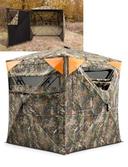
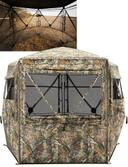
This is the problem the category exists to solve, and the TIDEWE 360 2-3 person blind is the answer: ten windows, mesh on all four walls, and the panel to shut it back down to 270 on the sits where you are the brightest thing in the woods. Most blown ground-blind sits are not caused by a hunter being seen — they are caused by a hunter still moving when the deer arrives, because he did not know it was coming. Seeing a deer commit at eighty yards is how you are already still and already drawn. The rest of the mistakes are in ground blind hunting mistakes.
If two of you are sitting, or you are shooting from a chair
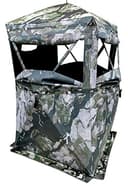
The five-sided TIDEWE. Its published low-hub frame puts the window openings below the hub line, which is the one spec on this page aimed at a seated shot with a rifle, a crossbow or a bow. TIDEWE publishes the five-sided shell as 60% more floor than a four-sided blind, and the entry as a silent flip-up door rather than a zip you fight with a bow in your hand. Understand the cost: Amazon lists it at 23.1 lb, the heaviest blind in this registry, so it is a drive-to blind. Pair it with real chairs rather than buckets — see best ground blind chairs.
If the blind has to disappear into cover
The Mossy Oak 360. It is the only pick that treats the outside of the blind as seriously as the view out of it: Country DNA on the shell, published exterior brush-in loops, 300D fabric on a metal frame. This matters more than it sounds on a see-through blind, because the mesh does nothing about the blind’s outline against a field edge or a skyline. Method in how to brush in a ground blind, and the one-way netting option for a blind you already own is in best camo netting for blinds.
If you want to find out whether you like the idea
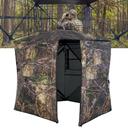
Start with the TIDEWE 270 or the FLISSA 360 and spend the difference on stakes and a chair. Both are cheap enough to be a second blind rather than a commitment, and the 270 in particular is the honest introduction, because the solid wall at your back is doing you a favor you will not notice until you hunt a 360 into a low sun.
If you want the one that will still be standing in five seasons
The Primos Full Frontal. It is the dearest pick here and the only one from a maker with a long blind history: a spring-steel assist door system, silent slide windows, brush straps along the window ridges, Veil camo. Its mesh is the front wall rather than all four, which is a narrower feature and a sturdier blind. If see-through is a nice-to-have rather than your reason for buying, read best ground blinds and how to choose a ground blind before you pay the see-through premium at all.
Setting one up so the mesh actually works
A see-through blind rewards a few habits that a solid blind forgives. None of them cost anything:
- Keep the interior dark.Wear dark, not camo; a light shirt inside a perforated wall is a lamp. This is the one blind type where a black face mask and gloves earn their keep — do you need camo in a ground blind.
- Put the solid wall, or the blackout panel, toward the sun. Not toward the wind, not toward the trail. The light gradient is the mechanism; protect it first and then work out your shooting arcs.
- Shoot an open window. Pick and open the two windows covering your likely lanes before daylight. No see-through panel here is published as shoot-through, and discovering that at full draw is a lost animal.
- Brush it in anyway.The mesh handles your detection problem, not the blind’s. A bare box with mesh walls is still a bare box.
- Stake and guy every corner.Fiberglass poles at 9.5 to 10 mm are the weak point in a gust, and a staked blind takes the load through the ground instead of the frame — best ground blind stakes.
- Set it weeks early if you can. Deer forgive a new object given time. Full timing logic in how to set up a ground blind.
What we left out, and why
Blinds with no live offer. Every pick here was confirmed with a live Amazon offer on the day this page was published. Several see-through blinds we looked at returned no offer at all, and a dead listing is worse than no recommendation.
Hard-sided and elevated blinds with glass. A tinted window in a steel box solves the same problem permanently and for several times the money. That is a different purchase, argued in best box blind for the money and ground blind vs box blind.
Any claim about how far away a deer can or cannot detect the mesh. We own no units, we have run no test, and no maker publishes a figure. What is established is the underlying vision: whitetails are dichromats with poor red and orange discrimination and good sensitivity to short wavelengths and to movement, which is why a dark interior and stillness matter more than the pattern on the shell. That science is in deer vision explained.
One-way netting as a pick.A roll of one-way netting added to the blind you already own is the cheapest route to some of this, and it is a legitimate answer — it is just not a blind. It is ranked in best camo netting for blinds.