What you are actually replacing
Before you swap anything, be clear about which job the suit was doing for you, because the alternatives are not interchangeable. A ghillie suit does four separate things at once:
- Breaks your outline in three dimensions.This is the real mechanism and it is the one a printed jacket cannot reproduce. Replace it with another 3D garment — a leafy suit, a leafy hood, a poncho — not with a better pattern.
- Masks small movement. Hanging material moves with you and with the breeze, so a hand lifting a call reads as texture rather than motion. Leafy suits do this nearly as well; a flat jacket does not do it at all.
- Covers everything, including your head. Most of what busts a seated hunter is the face, hands and the round shape of a head. A full suit covers all of it by default, which is why a partial alternative needs a headnet or balaclava added back.
- Hides you where there is no cover to hide behind. Open hardwood floors, cut fields, early-season green-up with no understory. This is the case where a ghillie earns its keep and the case where you should think hardest before dropping down to a poncho.
One thing a ghillie suit does notdo: anything about your scent. Covering your silhouette and beating a deer’s nose are separate projects with separate gear, and a hunter who solves the first and ignores the second still gets busted. That is the nose half of the problem, and no garment on this page touches it.
The alternatives, ranked by how much of the suit they replace
A leafy suit: the 90% answer
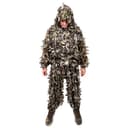
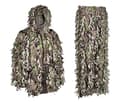
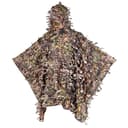
A 3D leafy suit is a ghillie with the thread bulk removed. Flat fabric leaves stitched to a light mesh shell give you the same shape-breaking texture in a garment you can pull over hunting clothes, pack small and move in. The trade is density: fewer, flatter leaves break up slightly less outline than a dense thread ghillie, and you make that back by adding local brush or sitting tighter to cover.
Leaf density is the spec that separates the three suits above — and it is the only spec any of them publishes. Not one leafy suit or ghillie in this registry publishes a garment weight, a fabric weight or a pattern license beyond the one hooded top that carries a licensed Mossy Oak print. If you want to know how a suit will wear in 70-degree weather, there is no published figure to read. That is worth knowing before you order, which is why the honest ranking here is on coverage and density rather than on numbers nobody prints.
A leafy hood or top: the 60% answer
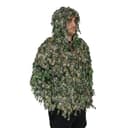
The head and shoulders are what gets picked off first, because they are what moves when you shift, call, or raise a weapon. A hooded leafy top covers both in one pull, goes on over your existing layers, and weighs under a pound. For a run-and-gun turkey hunter this is arguably a better buy than a full suit, and it is the piece most ghillie owners end up actually wearing.
A balaclava or headnet: the 20% answer, for 20% of the money
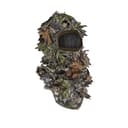
A 3D leafy balaclava blurs the round outline of a human head, which flat fabric does not. If your concealment is otherwise fine and you keep getting caught moving your face, this is the cheapest fix on this site. The broader comparison — including when a thin mesh headnet beats a leafy one — is in best hunting headnets and headnet vs face mask. Paint is the other route, and it is cheaper still: hunting face paint costs less than a sandwich and cannot snag a bowstring at all.
Netting: the alternative that is not a garment
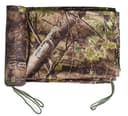
Here is the reframe worth the page. A ghillie suit solves “my body is visible.” For a hunter who sits in one spot, the real problem is usually “my position is visible.” Netting strung between two saplings, or wrapped around the base of a tree, hides you and your movement and your gear all at once, from every angle you are not shooting through — and it does it while you wear normal hunting clothes in normal comfort.
One-way see-through netting goes further: you watch deer approach through it without being seen, so you are settled and still before the shot rather than caught moving at twenty yards. That is the single most useful thing on this page for a stationary hunter. Setup method is in how to set up camo netting, the full netting comparison is in best camo netting for blinds, and if your sit is in a tree rather than on the ground, the elevated version is best camo netting for tree stands.
Natural cover: the free alternative
The best ghillie suit alternative costs nothing. A brushed-in natural blind made from vegetation that already grows where you are sitting beats every garment here on concealment, because it matches the backdrop exactly and it does not have to move when you do. It costs an afternoon and it cannot be relocated, which is the whole trade. How to build a natural ground blind is the method, and how to break up your outline is the principle behind all of it.
Which alternative fits which hunter
- Spring turkey, run and gun. The hooded leafy top, plus a leafy balaclava. You move constantly, you sit against trees rather than in cover, and a bird will catch you at forty yards. Our species-specific picks are in best camo for turkey hunting.
- Early-season bow from the ground. The leafy suit, and check every strand against your string before you draw. Loose material and a bowstring is the one failure on this page that costs you an animal rather than a little comfort.
- Hunting from inside a blind. None of this. A blind with a dark interior does the outline work for you; wearing a ghillie in a hub blind is heat and snag for no gain. The argument is laid out in do you need camo in a ground blind, and the blinds themselves start at best ground blinds under $200.
- Late season, cold, sitting still.A ghillie’s heat becomes a feature, so this is the case where you might not want an alternative at all — or you want the leafy suit over an insulated layer rather than a thin one. Layering is in how to layer for cold weather hunting.
- Public land, long walk in. The poncho, because it weighs nothing and lives in a pocket. A suit you left in the truck conceals nobody.
- A fixed spot you hunt all season. Netting or natural cover. Build it once, wear normal clothes forever.
Three alternatives that do not work, and why
A better camo pattern. Swapping one printed pattern for another does nothing a ghillie was doing, because the mechanism is different: print works on detail at close range, 3D texture works on shape at distance, and deer judge shape first. Deer are also dichromats, so the pattern differences hunters argue about are substantially invisible to the animal. We go through the evidence in does camo matter for deer hunting and deer vision explained.
Military surplus. A woodland-pattern uniform is flat fabric in colors chosen for a different continent and a different observer. It is not a ghillie alternative in any sense that matters; see is military camo good for hunting.
Sitting still and hoping.Stillness is the prerequisite, not the replacement — it is what makes any of this work, and it is free. But a motionless human shape against sky is still a human shape. Pair whatever you buy with the discipline in how to stay still while hunting.
If you decide the ghillie was right after all
That is a legitimate conclusion, and the honest version of this page has to say so. In open terrain with no cover to use, on a spot-and-stalk hunt, or for a predator hunter who needs to disappear on bare ground, the full suit is still the best tool and every alternative above is a compromise. Our picks, including the complete kits that come with a gun wrap, are in best ghillie suits. The efficacy question for whitetails specifically — where the answer is more nuanced than either camp claims — is in do ghillie suits work for deer hunting, and the head-to-head is ghillie suit vs leafy suit.
One last note on legality, because it comes up with every full-coverage garment: blaze-orange requirements apply to what you wear during firearm seasons regardless of how well your concealment works, and a ghillie or leafy suit does not exempt you. Several states also regulate blaze orange on a ground blind itself. Check your own regulation, and read do you need blaze orange for bow season before you assume archery season is exempt.