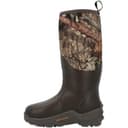
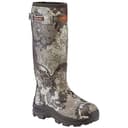
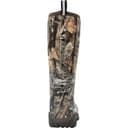
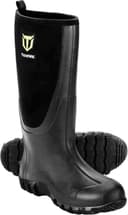
The short answer
For the sit, wear the hunting boot. For a long walk in, there is a real case for the hiking boot — and the best answer is usually both.
The two boots are not competing versions of the same product. They are solutions to opposite problems. A hiking boot exists to move a foot efficiently over distance and get moisture out. A rubber hunting boot exists to keep a stationary foot warm and keep scent in. Buy the one that matches what your feet are actually doing for most of the hunt, and if the hunt has two distinct halves, accept that it has two distinct boots.
Why this is a scent question before it is a comfort question
Everything above your ankles can be washed, sprayed, stored in a sealed tote and carried to the blind. Your boots cannot be any of those things, because they are the one piece of gear that is pressed into the dirt on your entry route for the entire walk in.
That matters because of where the scent ends up. Scent on your jacket is at five and a half feet and drifts with the wind. Scent off your boots is on the ground, at exactly the height a whitetail’s nose travels, and it stays there after you have gone past — which is the whole argument of how to control boot scent. A deer crossing your trail two hours later does not need the wind to cooperate.
Now put the two boot designs next to each other. A hiking boot is a stitched assembly: leather or synthetic panels, mesh ventilation, a tongue gusset, a waterproof-breathable membrane whose explicit purpose is to let water vapor out. Every one of those features is a deliberate path for moisture — and moisture carrying foot odor — to leave the boot. A knee-high rubber or neoprene hunting boot has no stitched seams below the cuff, no mesh and no membrane. It is a sealed bag.
Here is the honest limit, though. A rubber boot does not make you scent-free, and we are not going to imply it does. Research reporting on scent-control products is consistent that complete scent elimination is not achievable, and the whitetail nose is good enough that the reasonable goal is managing where your odor is deposited rather than eliminating it. The boot reduces the ground trail. It does not delete it. That is why whether scent control works is a question with a nuanced answer on this site rather than a sales pitch.
Insulation: the spec a hiking boot does not have
This is the difference most hunters feel first, and the reason the categories are priced and sold differently.
Hiking boots are mostly uninsulated by design, because a hiker is generating heat continuously. The boot’s job is to shed the heat and moisture that activity creates. A hunter in a blind does the opposite: walks in, warms up, sits down in a chair, and then produces almost no heat for four to six hours while the temperature falls. That is a completely different thermal problem, and it is why rubber hunting boots are sold by insulation weight — 400g, 800g, 1,200g — the way sleeping bags are sold by temperature rating.
If you have ever been perfectly comfortable hiking in and had numb toes an hour into the sit, that is not a boot failure. It is a category mismatch. The fuller version of the problem is in how to keep your feet warm hunting, and the short version is that cold feet in a blind are usually a moisture problem rather than an insulation one — which loops straight back to the walk in.
The one thing hiking boots do better, and it is not small
Walking. Hiking boots are better at walking, and if your hunt involves a real walk the difference is not a matter of taste.
A hiking boot has an engineered midsole, a lugged outsole tuned for grip on loose ground, a laced upper that locks your heel so your foot does not slide, and ankle support. A knee-high rubber boot has a pull-on neoprene shaft, a soft sole and no lacing at all, which means your heel lifts on every step and the boot flexes where your foot does not want it to. Over a mile that is tolerable. Over four miles on uneven public ground in the dark, it is blisters and a slower, noisier walk.
The weight question is where the registry comes up short and it is worth naming: none of the four rubber boots above publishes a weight. If you are comparing a known 2 lb hiking boot against an unknown rubber boot for a long approach, you are comparing one real figure to a blank, and that blank is itself information about how the category is sold.
There is also a noise dimension that cuts the other way. A stiff lugged hiking sole on dry leaves and gravel is louder than a soft rubber sole — the last two hundred yards is where a hunting boot wins the walking argument back. If you have not thought about the sound of your approach, start with the approach half of concealment and silencing your gear.
Water, which is not really a contest
A waterproof hiking boot keeps liquid water out up to the ankle. A knee-high rubber boot keeps liquid water out up to the knee. LaCrosse publishes an 18-inch shaft on the Alphaburly Pro; Dryshod publishes a shaft two inches taller than its standard line on the Viperstop. There is no hiking boot in that conversation.
If your access route crosses a creek, a flooded field edge, a beaver slough or knee-high wet grass at dawn — and most good blind access routes deliberately do, because water is a scent barrier as much as a terrain feature — the rubber boot is the only one of the two that works. Wet feet at first light ruins the sit regardless of how well the boot breathes.
The two-boot plan, which is what experienced hunters actually do
If your access is more than about half a mile and the weather is above freezing, split the hunt into its two halves and dress for each one.
Walk in wearing what moves well.A hiking boot or trail shoe, laced properly, on a route chosen so you are not walking through the bedding area. Accept that you are leaving more ground scent on the approach and solve it with the route instead of the boot — which is the argument in playing the wind on public land.
Carry the hunting boots. On the outside of the pack, not inside it, so the pack stays dry. Yes, it is weight. It is also the difference between arriving dry and sitting in a boot you sweated into.
Change at the blind, outside it. Swap boots before you go in, which keeps the mud and the walked-in ground scent out of the blind you intend to sit in repeatedly. Put the hiking boots in a bag if you are fussy about it.
And add the foot layer the boot cannot provide. A boot blanket or a heated sock does more for a stationary foot than another 400g of insulation, because the problem in hour four is circulation, not R-value. See boot blankets and heated socks.
When the hiking boot is simply the right call
Four cases, stated plainly, because a hunting site that pretends hiking boots have no place is not being useful.
Early-season scouting and camera runs. You are walking, it is warm, you are not hunting that day. Wear the comfortable boot.
Long, dry, mountainous access. A three-mile climb to a hang-and-hunt spot is a hiking problem. Western and mobile hunters almost universally wear hiking or mountain boots for this reason, and a saddle hunter carrying sticks and a platform has enough weight already.
Hot, dry early season with no water crossing. An uninsulated rubber boot in 80-degree weather is a sweat box, and a sweaty foot is generating exactly the odor the boot was supposed to contain.
When it is the only boot you own. This matters more than gear writing usually admits. Hunting in a hiking boot you already have is far better than not hunting, and the route you choose, the wind you hunt and the cheap half of scent control will do more for you than any boot upgrade.
So what should you buy?
Blind or box-blind hunter, short walk, cold weather: an insulated rubber hunting boot, and size the insulation to how long you sit rather than how cold the morning is.
Blind hunter, long walk, mild weather: two boots. Hike in something breathable, change at the blind.
Early season or snake country: a tall uninsulated rubber boot, which gives you knee-high coverage and no insulation to overheat in.
Mobile, saddle or public-land hunter covering real distance: a hiking or mountain boot, and manage your ground scent with the entry route and the wind instead of the boot. Our mobile-hunt packing guide assumes you walk in wearing what walks best.
Buying one boot for everything: a mid-insulation rubber hunting boot is the better single purchase for a hunter who hunts from blinds, because the thing it does badly (walking far) is survivable and the thing a hiking boot does badly (keeping a stationary foot warm and dry to the knee) ends the hunt.