Where a ghillie suit genuinely wins
1. Open terrain with nothing to hide behind
This is the situation the suit was made for. A cut field, a pasture edge, a burn, a clearcut — ground where there is no trunk to break you up and no blind to sit in. Here the suit is your cover, and the difference between a 3D suit and a printed jacket is not subtle. How to hide in open terrain is the companion piece, and hunting a clearcut is the most common real-world version.
2. Spring turkey, where you move and get stared at
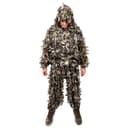
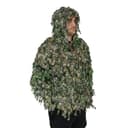
Turkeys have better eyes than deer by any measure and you have to call, shift and re-position with a bird looking at you. A lightweight 3D suit with a hood — covering the two things that give hunters away, the head and the hands — is close to standard equipment for run-and-gun turkey hunting, and that is a better-evidenced use case than deer hunting. The lighter and more breathable the better, because spring mornings warm up fast.
3. Building a natural blind, as the finishing layer
The combination that actually works on the ground: sit inside natural cover you have arranged, and wear something three-dimensional so your edges match the stuff around you. The suit is not doing the job alone — it is removing the last hard line. How to build a natural ground blind and brush blinds and natural concealment are the setup half of this.
Where it costs you the hunt
Heat, and therefore movement
A full thread ghillie is hot and heavy, and the makers say so. An uncomfortable hunter fidgets, and fidgeting is precisely the thing deer vision is best at detecting. In early-season warmth a full ghillie can be a net negative purely through the restlessness it causes — which is why the lightweight suits exist and why we rank one first.
Bowstrings
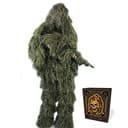
This is the serious one. Loose strands and a bowstring are a bad combination: material caught at the shot ruins arrow flight and can injure your forearm. The full ghillie we list carries exactly this warning — it snags on brush and can foul a bowstring, which makes it a gun and observation piece rather than an archery one. If you bowhunt, use a 3D leaf suit, wear an arm guard, and shoot the setup at a target before you take it hunting. Ghillie suit vs leafy suit covers the trade in full.
Noise and snagging on the walk in
A suit that catches on every multiflora rose between the truck and your spot is a suit that announces you for a quarter mile. Carry it in and put it on when you get there. That is also the answer to the heat problem.
It does nothing about your scent
Worth saying because the suits look so dramatic that people expect them to solve more than they do. A deer that smells you does not care what you look like. The outline work is real and the nose problem is untouched — how to beat a deer’s nose and scent control vs hunting the wind are the pages that matter for that half.
The blaze orange problem
During firearm seasons the suit does not get you out of the orange requirement, and the requirement is substantial. Texas requires 400 square inches of hunter orange plus orange headgear on public land during firearm seasons. If you are hunting from a fabric ground blind on public land in Minnesota, the blind itself needs blaze orange on top visible for 360 degrees or at least 144 square inches on each side. Rules differ by state; read yours.
The reassuring part is that wearing it costs you less than it looks like it should. The foundational electrophysiological work on whitetail and fallow deer measured cone sensitivities around 450–460 nm and roughly 537 nm — blue and green-yellow — with no receptor tuned to the red and orange end of the spectrum. Peer-reviewed review work since then describes deer as dichromats for whom blaze orange reads as a muted tone rather than a beacon. A vest over a 3D suit is a smaller concealment cost than the heat of a suit you cannot sit still in. Can deer see blaze orange has the detail and blaze orange vs camo weighs the two.
The verdict
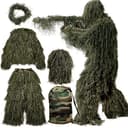
Buy a 3D leaf suit if you hunt on the ground in open country, chase spring turkeys, or sit in natural cover without a blind. Buy a full thread ghillie only if you gun hunt and outline breakup is your whole strategy. Buy neither if you hunt from a blind or a tree stand — you have already solved the problem the suit solves.
And if you are in the market because your real question is whether camo matters at all, the honest answer is on does camo matter for deer hunting: less than stillness, less than wind, and a great deal less than where you set up. A ghillie suit is the one camo product that genuinely attacks something deer are good at — which is exactly why it is worth being specific about when it helps.
The full lineups are in best ghillie suits and best leafy camo suits, and how to use a ghillie suit covers adding local vegetation, which is the step that doubles whatever you bought.