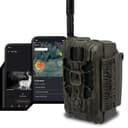
What you are actually buying
A trail camera answers a question. A cellular trail camera answers it without you walking in there. That is the entire product. Image quality, burst modes, AI tagging and live view are all downstream of the one thing that matters, which is that your scent, your boots and your truck door stay out of a spot you intend to hunt.
That reframes the buying decision completely. The spec sheet a maker leads with — megapixels — is close to irrelevant: a 40MP image of a deer at 60 feet in the dark is not meaningfully more useful than a 28MP one. The specs that decide whether the camera does its job are the three nobody puts on the front of the box: what the data plan costs over three seasons, how long the camera runs without a visit, and whether the flash gives it away.
The criteria, in the order they decide the buy
1. The plan, priced over three seasons
This is the number that actually separates these cameras, and it is the one every brand buries. Hardware is a one-time cost; the plan is a recurring one. Over three seasons a mid-tier subscription will usually cost more than the camera it feeds, and if you run several cameras it is not close.
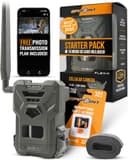
SPYPOINT is the only maker here that publishes a genuinely free tier — 100 photos per month per camera at $0, confirmed on its own plan page. Read that figure precisely: 100 a month is a little over three a day. On a feeder or a mineral site with a three-shot burst, the month is spent in a weekend. On a single trail at a pinch point, set to one photo per trigger, 100 is a workable amount of information. Moultrie, Tactacam and Stealth Cam all require a paid plan to do the thing you bought the camera for, so price the subscription before you price the body.
2. Power, measured in trips you do not take
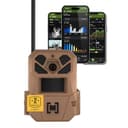
A cellular camera that needs batteries in October has undone its own purpose. Cellular radios draw real current, and the makers are noticeably quiet about the consequences: Moultrie publishes no battery type, no battery life and no waterproof rating for the Edge 3, and sells a separate power pack — which tells you what it thinks of the internal cells.
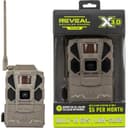
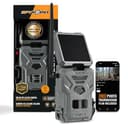
Two of the picks below attack the problem honestly. Tactacam publishes a twelve-AA battery bay and a DC 12V external input on the Reveal X 3.0, which is the largest stated battery capacity on this page. SPYPOINT puts a solar panel on the FLEX-S-DARK, which removes the battery trip entirely — provided the camera can see sky. Under a closed canopy a solar panel is decoration. Pick your mounting spot for the sun, not for the prettiest camera angle, and accept a short cable run if you have to.
3. The flash, and whether deer notice it
Most cameras use an 850nm low-glow infrared array, which emits a faint red glow at the lens when it fires. A 940nm no-glow array does not. Whether whitetails care is argued among biologists and is not a settled question — what is not argued is that people notice a glowing camera, which matters on public ground where cameras walk off. And on a trail where an older buck has already shifted to full dark, a flash he cannot see is worth more than one that lights up his face.
No-glow costs you reach and night-image brightness. That is physics, not a defect: the same LED power at a longer wavelength puts less visible light on the subject. Two picks here solve it in different ways — the Stealth Cam Deceptor MAX 3.0 pairs 940nm no-glow with the fastest published trigger on the page, and the SPYPOINT FLEX-S-DARK pairs no-glow with solar and the free plan.
4. Trigger speed, and the one spec most makers hide
Trigger speed decides whether you get a photo of a deer or a photo of the brush it walked through. The figures published here run from 0.3 seconds (Stealth Cam Deceptor MAX 3.0, SPYPOINT FLEX-S-DARK) through 0.4 (FLEX-M) and 0.50 (Moultrie Edge 3) to Tactacam’s vaguer “sub-1/2 second.” Any of those will catch a deer that pauses. A deer crossing at a walk is where the difference shows, and it is worth noting which makers decline to publish an exact number at all — it is usually the slow ones.
Recovery time matters almost as much and is published even less often. A camera with a quick trigger and a slow recovery photographs the first deer in a group and misses the buck trailing it. Our full trail-camera roundup covers one non-cellular camera that publishes both figures, which is still rare in this category.
Cellular or not: the honest comparison
The comparison is no longer cellular versus non-cellular on image quality. Good cellular cameras now cost roughly what a good non-cellular camera cost a few years ago. The real comparison is cellular versus walking in, and that depends entirely on the ground.
Buy cellular when the trip is expensive.A camera watching a bedding-area entrance, a staging area inside a small property, or a public-land spot that is a two-mile walk from the truck — those are the cameras worth paying a subscription for, because every card pull costs you scent, noise and sometimes the sit itself. Our guide to hunting small properties makes the same argument about access: on forty acres there is nowhere to make a mistake.
Buy non-cellular when the trip is free. A camera on a field edge you drive past on a tractor, or on a trail you can check on the way out of the woods anyway, does not need a data plan. Spend the subscription money on another camera body instead and cover another trail.
Do not buy cellular to make up for a bad spot.A camera in the wrong place sends you photographs of nothing, faster. Placement, not connectivity, decides whether a photo is useful — see where to put a trail camera before you spend anything. The same caution applies to everything else sold as a shortcut: knowing from your photos that a buck uses a trail is what makes calling at him worth trying at all.
How many cameras, and where
If your question is “what is using this trail,” one camera answers it. If your question is “what lives on this property,” one camera cannot answer it at all.
Purdue University Extension’s published trail-camera survey method asks for roughly one camera per 100 acres, run for 10 to 14 days, mounted about waist height — two and a half to three feet — with the camera faced north or south so the sun does not blow out the frame, burst mode off, and a five to ten minute delay between triggers. It also tells you to check your state’s feeding and baiting law before you put bait anywhere near a camera. That is a real method with real numbers, and the first number tells you that a single camera is a spot-watcher, not a survey.
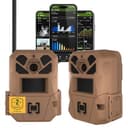
Two practical consequences. First, the 2-pack below is usually the cheaper route to two locations, which is worth comparing against two single listings at the live price. Second, two cameras means two data plans — the subscription scales with the hardware, and that is the cost that bites in year two.
Set it up so it does not cost you the hunt
Hang it once, in August. Every visit is scent and noise on ground you intend to hunt. Pick the spot, set the camera, and if it is cellular you should not need to come back. Our scouting guide covers the reading-the-ground half of that decision.
Point it along the trail, not across it. A camera square to a trail gets one frame as the deer crosses the detection zone. A camera angled 30 to 45 degrees down the trail keeps the deer in frame for several feet, which covers for a slower trigger and gives you a side profile instead of a rear end.
Turn the burst off and the delay up. This is the single setting that decides whether a free or cheap plan is usable. One photo per trigger with a five-minute delay turns a feeder from a data-plan disaster into a readable log.
Test the signal before you walk away.Every camera here has an app that reports signal strength at the camera. Check it standing at the tree, not from the truck. A spot with no bars is a non-cellular camera with a subscription attached — and this is where Tactacam’s published 8GB of onboard storage earns its place, because the camera keeps recording whether or not the network cooperates.
Mind the law.Trail-camera legality is a state-by-state question and it has moved fast. Utah’s administrative rule R657-5 defines a trail camera as a device not held or operated by a person that captures images, video or location data using heat or motion, restricts where one may be placed or used, and makes it unlawful to buy or sell trail-camera media to take or aid in taking big game. Other states restrict cellular transmission during open season specifically. Read your own regulations for the season you are hunting — and if you hunt public ground, read the camera rules at the same time you read the public-land access rules.
What we did not include, and why
Satellite cameras.They exist and they solve a genuine problem — ground with no cell coverage at all — but they cost more per body and per month than anything here, and the hunter asking “which cellular camera” is almost never the hunter with zero bars.
Security-camera crossovers. A cellular camera sold for driveways will photograph deer, but the detection zone, flash and battery management are tuned for a different job.
Any camera we could not confirm as currently purchasable. Every pick above was checked against a live retail listing before it went on this page, and every spec was read from the maker’s own published page where one exists. Where a figure is not published — battery capacity on the Moultrie, solar output on the SPYPOINT, an IP rating on the Tactacam — the spec table says “Not published,” because that gap is itself a finding about this category.