The short answer
For hunting from a blind, a stand or anywhere in timber, buy the 8x42. You get a brighter image at the two times of day you are actually hunting, more eye relief, an image that does not shake, and — depending on the model — some extra field of view. The first three are published numbers and they point the same way in every pair we could find a table for.
Buy the 10x42 if your hunting is open country— big fields, cut agriculture, river bottoms you glass from a tower blind, or Western terrain where you need to judge an animal at 400 yards and beyond. At that distance the extra magnification does real work an 8x cannot, and you will be resting the glass on something anyway.
Everything else here is a consequence of those two sentences. The rest of this page is the published figures the answer is built on — including one popular argument for 8x that turns out to be much weaker than it is usually stated.
What the numbers actually say
The clean way to see the trade is to compare the same binocular in both magnifications, because then the glass, the coatings, the body and the price are held constant and only the magnification changes. Two makers publish full tables for both versions of a 42 mm model.
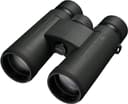
Nikon PROSTAFF P3 8x42 against PROSTAFF P3 10x42, from Nikon’s own specification table:
- Exit pupil: 5.3 mm against 4.2 mm.
- Relative brightness:28.1 against 17.6 — the 8x42 figure is about 60 percent higher.
- Eye relief: 20.2 mm against 15.7 mm.
- Field of view at 1,000 yards: 377 ft against 367 ft. Real angular field 7.2 degrees against 7.0.
- Close focus: 9.8 ft on both.
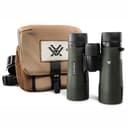
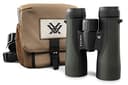
Vortex Diamondback HD 8x42 against Diamondback HD 10x42, from Vortex’s own specification pages:
- Field of view at 1,000 yards:393 ft against 330 ft — a 63-foot gap, 7.5 degrees against 6.3.
- Eye relief: 17.0 mm against 15 mm.
- Close focus:5.0 ft against 5 ft — identical.
- Weight: 21.8 oz against 21.3 oz. There is no weight saving either way.
- Exit pupil: Vortex publishes it for neither model.
The field-of-view argument is real, but smaller than you have been told
“8x gives you a much wider field” is the most repeated line in this debate, and the two tables above show it is maker-dependent rather than a law of optics. Vortex’s pair differ by 63 feet at 1,000 yards, which you would notice. Nikon’s pair differ by 10 feet, which you would not — Nikon achieved a 7.0-degree real field at 10x, nearly matching its own 8x.
The practical lesson is to read the table for the actual model you are buying rather than trusting the magnification to tell you the field. If wide field is your priority and you are choosing between brands, that number is published and comparable, so use it.
Eye relief and exit pupil are where 8x wins every time
These two move in the same direction in every pair that publishes them, and they are the reason the recommendation is not close for close-cover hunting.
Eye reliefis how far behind the eyepiece your eye can sit and still see the whole field. If you wear glasses, your eye is already pushed back, and short eye relief shows up as a black ring cropping the field you paid for. Roughly 16 mm is the usual working minimum for a glasses wearer. The published figures put Nikon’s 10x42 at 15.7 mm and Vortex’s at 15 mm — both under it — against 20.2 mm and 17.0 mm for the 8x versions. If you hunt in glasses, this spec alone comes close to deciding.
Exit pupil is the diameter of the light column reaching your eye, and it is the objective divided by the magnification: 5.25 mm at 8x42 and 4.2 mm at 10x42. That is arithmetic from the model name, not a claim about a particular pair. It matters because a dark-adapted human pupil opens wider than either figure, so at last light your eye is bigger than the column a 10x42 hands it. Nikon states the figures and the derived relative brightness; Vortex publishes neither for the Diamondback HD, which is worth knowing before you compare brands on brightness claims. Where a maker does not publish a number, this site says so rather than filling the gap.
Dawn and dusk are when whitetails move, and the peer-reviewed review of cervid visual ecology describes eyes built for exactly that — tuned for motion detection in low light rather than fine detail. You are hunting an animal optimized for the two half-hours when a 10x42 is at its weakest.
Hand shake: the advantage nobody publishes
Magnification multiplies your own tremor along with the image. At 10x a small wobble becomes a visible swim in the view, and after a cold three-hour sit it gets worse rather than better. At 8x the same wobble is 20 percent smaller.
There is no spec for this and no maker will print one, but it is the most commonly given reason hunters who own both reach for the 8x. If you do buy 10x and plan to glass for long stretches, plan on resting it — a window frame, a pack, a knee, or a tripod adapter. Both Diamondback HD models are published as tripod adaptable.
Why a blind window changes the answer
A blind window is a fixed frame. You cannot sweep a hillside; you can only look at the slice the window gives you, from a seated position, often with a hood or a face mask in the way and your elbows somewhere awkward. Three things follow.
Finding beats measuring.A whitetail inside 100 yards does not need magnifying, it needs locating — and in hardwoods it appears and disappears behind trunks while you are trying to get on it. Field of view and a steady image do that work; magnification does not.
Eye relief does more in a blind than anywhere else. You are bringing the glass up at an angle you did not choose, past clothing you are wearing for concealment. Longer eye relief is forgiving of all of it.
You are hunting the edges of the day. Blinds get hunted hardest in the first and last half hour, which is exactly where the exit-pupil difference lives. If you also run cellular cameras to know when deer are moving, you will find most of your daylight pictures land in those same windows.
One more blind-specific note: do not glass with the binocular resting on the window sill. Fabric creeps, the frame is rarely level, and the movement of settling the glass on it is movement in a window. Rest your elbows, not the optic — the same argument our blind gun-rest page makes about rifles.
Where the 10x42 genuinely wins
This is not a page arguing that 10x is a mistake. It is the right tool for a specific job, and the job is judging rather than finding.
- Open country. Picked fields, CRP, river bottoms, Western basins. When your average detection distance is 300 yards and up, 10x resolves detail an 8x will not.
- Judging antlers and age at distance. Deciding whether a buck across a half-mile field is the one you are after is a resolution problem, and resolution is what the magnification buys.
- Glassing from a tower or box blind. You are elevated, you have a sill-height rest available and long shooting lanes to scan. Shake is handled by the rest, and the field penalty matters less over open ground. Our box blind picks cover the elevated setups this applies to.
- Doubling as a general-purpose optic. If one pair has to cover whitetails, Western elk and summer scouting from a ridge, 10x is the more versatile compromise.
What about 8x32, 10x50 and 12x50?
Three questions that always follow this one, answered on published numbers.
8x32 instead of 8x42?You save real weight — Nikon publishes 16.8 oz for the PROSTAFF P3 8x30 against 20.3 oz for the 8x42 — and you gain field (456 ft at 1,000 yards). You pay with a 3.8 mm exit pupil, the smallest figure in this category, and you pay at dusk. A compact is a superb second binocular for a mobile hunter and a questionable only binocular for a dawn-and-dusk whitetail hunter. Our binocular roundup ranks both and prints the trade.
10x50 instead of 10x42? A 50 mm objective at 10x gives a 5 mm exit pupil, so you get 10x magnification with roughly 8x42-class brightness. The cost is bulk: a 50 mm binocular is a noticeably bigger object hanging on your chest in a blind and slower to bring up through a window. Worth it for a dedicated glassing setup, usually not as your hunting binocular.
12x50 or higher?Tripod glass. Hand-holding 12x for any length of time is unpleasant, and the field is narrow enough that finding the animal becomes the hard part. If you want this much magnification, budget the tripod at the same time — our tripod and shooting-rest picks cover heads that will carry an optic.
How to choose in one minute
Answer the first question that applies to you and stop.
- Do you wear glasses while hunting? Buy the 8x42. The eye-relief figures settle it.
- Is most of your hunting inside 150 yards — timber, blind windows, field edges? Buy the 8x42. You need to find deer, not measure them.
- Do you hunt the first and last twenty minutes hardest? Buy the 8x42, for the exit pupil.
- Is your typical deer 300 yards out or further? Buy the 10x42.
- Will you be judging antlers at distance, or glassing from a rest for long stretches? Buy the 10x42.
One rule overrides all five: a 42 mm binocular on your chest beats a better one in the truck. Every pick below is published between 20.3 and 21.8 oz, light enough to wear all day in a harness under a jacket. The worst binocular is the one you left behind because it was heavy.