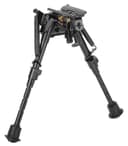
What a blind demands that a field rest does not
Height adjustment you can make seated, with one hand
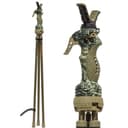
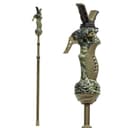
This is the whole category in one sentence. Standing in a field you can adjust a rest with both hands and your whole body. Seated in a blind, one hand is on the gun, your knees are against the wall, and the deer is already there. A trigger-adjust mechanism — squeeze, slide, release — is worth paying for here in a way it is not in an open field, and it is why both Primos sticks place highly on this page despite the premium.
Footprint, because a hub blind has none to spare
A tripod inside a compact hub blind competes for floor with your chair, your pack and your feet. Three legs splayed to a stable width can take most of the floor in a one-person blind, which is why the monopod is a genuine answer and not a compromise: one leg, between your boots, adjusted the same way. You steady the side-to-side sway yourself, which is a real cost and an acceptable one at 80 yards from a seated position with your elbows on your knees. If floor space is your constraint, what size ground blind you need is the other half of this problem.
Silence, which is mostly about what the rest touches
Aluminium against a blind’s frame or window edge is the loudest sound you can make in a blind, and a rest is a long aluminium object you move in the dark. Two habits fix it: set the rest up and set your height beforelegal light, and keep the legs on the blind’s floor mat rather than on bare ground or a hard floor panel. A mat also stops the legs sinking unevenly in mud, which is the quiet cause of a rest that will not stay level — see blind flooring and how to silence your hunting gear.
A hands-free option, for the hunter who cannot stay still
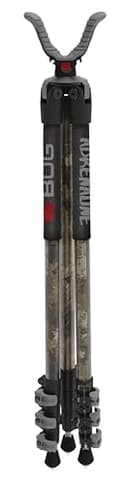
The clamping tripod is a different proposition: its jaws hold the rifle for you, so you can take both hands off the gun, warm them up, lift binoculars, and come back to a weapon that is still pointed where you left it. In a blind, where every movement is the thing that gets you caught, that is a bigger advantage than it sounds. BOG publishes a hands-free gun clamp on the DeathGrip and it is genuinely heavy — a haul to carry in, irrelevant once it is in a blind you drive to. The cost is a step: clamping and unclamping before the shot.
Why the window sill is the worst rest in the blind
Almost everyone tries this first. Resting the forend on the window frame or the blind’s shell seems free, and it fails three ways. It couples your rifle to a fabric structure that moves in wind, so your crosshair breathes with the blind. It puts metal against metal or metal against taut fabric, which is a noise with a click in it. And it fixes your muzzle height at exactly one value — the sill — so the only way to adjust elevation is to move your whole body, which is the movement you were trying to avoid.
A rolled jacket or a pack on the sill is better than nothing and is the cheapest answer available, but it changes height every time you compress it and it does not help at all when the shot is steeply downhill out of an elevated blind. If you hunt from a box blind the sill problem is worse, not better, because the walls are rigid and the window is higher — how to hunt from a box blind covers that setup.
Tripod, monopod or bipod: pick by what is limiting you
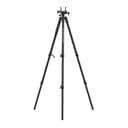
Pick a tripod if you have the floor space and you want the steadiest rest available seated. This is most gun hunters in a 2-person or larger blind.
Pick a monopod if your blind is compact, or if you also still hunt and want one stick that walks, glasses and shoots. It is the versatile choice and the lightest.
Pick a bipodif your window sill is genuinely low — a ground-level blind with a 6-to-9-inch rest height works, and a rifle-mounted bipod has the unique advantage of always being there and always aligned. It is useless for a standing or high-window shot. The full comparison is in bipod vs tripod shooting rest.
One spec to note across this whole category: height range and weight are mostly not publishedon these listings, and we render them as “Not published” rather than guess. The exception is the Caldwell bipod, which publishes a 6-to-9-inch height — which is precisely why it is the clear answer for a low sill and the clear wrong answer for anything else. When a maker will not publish a height range, measure your own window sill from your seated shoulder before you buy, and buy the adjustable one.
While you are buying: the blind-specific extras that matter more
A rest fixes your rifle. Three cheaper things fix the hunter. A chair at the right height does more for your shooting position than any rest — blind chairs. Staying warm keeps you still, and stillness is concealment — how to stay warm in a ground blind. And if you are hunting gun season on public land, the blind itself may need blaze orange on it before any of this matters; our rifle blind rankings go through the state requirements.