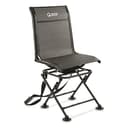
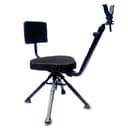
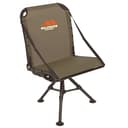
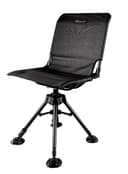
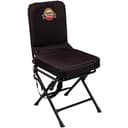
How to choose a ground blind chair
Rank the features by how they affect your hunt. First, a truly silent swivel— test that it turns smoothly with no squeak or click, because the moment of truth is exactly when you can’t afford a sound. Second, back support and seat depththat let you sit still for hours; all-day sits are won by the hunter who isn’t shifting to relieve a sore back. Third, adjustable heightso your eye lines up with your blind’s shooting windows rather than forcing you to hunch or crane.
Seat height: the number nobody publishes
Here is a finding worth stating plainly, because it is the same on every chair on this page: none of these makers publishes a seat height. Our spec tables say “Not published” rather than inventing a figure, and that matters because seat height is what decides whether your eye and your shoulders line up with the blind’s shooting window. Sit too low and you crane and lean into every shot; sit too high and your head is silhouetted in the opening you are trying to shoot through.
Since you cannot buy on the number, measure instead. Set the blind up in the yard, sit on a bucket or a box, and find the seat height at which the bottom edge of your main shooting window sits at about mid-chest — that puts your eye above the sill with your torso still inside the dark interior, and it gives a bowhunter room to rotate under the top edge. Then buy the chair that adjusts to that height, or shim the one you own. A height-adjustable chair is worth the premium precisely because blinds differ: the Millennium G100 adjusts, most budget swivels do not.
Check the footprint against your blind floor
A chair that fits the blind on paper can still pin you against a wall in practice, because you need clearance around the legs, not just under them. Two rules of thumb: leave enough room behind the chair that you can sit backfrom the window rather than up against it, which is what keeps you in shadow; and leave enough beside it that the legs never touch a wall, because a chair leg resting on blind fabric transmits every shift straight into the shell. In a compact solo blind, a wide four-leg swivel base is usually the wrong choice — take the narrower frame and spend the saved floor on sitting deeper. If you are pairing a chair with a new blind, our bow-blind roundup lists the published floor dimensions where makers state them.
Silencing the chair you already own
You do not always need a new chair; you often need a quiet one. Work through the noise sources in order: swivel pivots and any bare metal-on-metal joint, the hinge points where a folding frame closes, the feet where they contact the floor or mat, and the fabric seat where it stretches under load. A dry pivot is the usual culprit and the easiest fix. Wrap the feet or set the chair on a floor mat so they cannot grind on grit, and keep the frame clear of the blind walls. Then test it the way you will use it: sit down, close your eyes, and rotate slowly through a full circle listening for the click that will happen at fifteen yards. The broader routine is in how to silence your hunting gear.
Match the chair to how you hunt
A hunter on a fixed set can bring a heavier, padded swivel throne and leave it in the blind. A mobile hunterpacking in needs something light and compact that still supports the back — a real trade-off, since the plushest chairs are the bulkiest. Check the footprintagainst your blind’s floor space so the chair fits without pinning you against a wall, and make sure it’s stable on uneven ground. Then keep every movement slow: even the best chair only helps if you use its quiet swivel instead of standing. Pair it with the right blind from our best ground blinds guide.