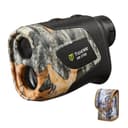
How to choose a hunting rangefinder
1. Angle compensation is not optional, and it is not a gimmick
A laser measures the straight line from you to the deer. Gravity acts on the horizontal component of that line. Shoot steeply downhill from an elevated box blind and the two numbers diverge: hold for the line-of-sight reading and the shot goes high, because the arrow or bullet is covering less horizontal ground than the laser measured.
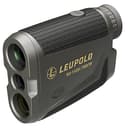
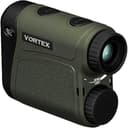
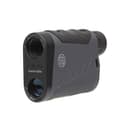
Every brand names this differently. Vortex calls it HCD (Horizontal Component Distance) and publishes a maximum angle reading of 60 degrees in either direction. Leupold builds it into TBR/W, SIG calls it AMR. The name does not matter; having it does, and so does leaving it switched on. The error is small on flat ground and grows with the angle, which means it matters most precisely where blind hunters sit high — a tower blind, a hillside, a creek bottom you are shooting down into. A unit with no published angle-compensation detail at all is a unit that leaves that math to you.
2. For bowhunters, the clearance question beats the distance question
This is the feature most hunters have never heard of and the one that is worth real money in a blind. Leupold’s Flightpath, once calibrated to your bow’s numbers, displays the highest point your arrow reaches on the way to the target — so you can tell whether the shot clears the top of the window, the limb across the lane or the brush you tucked the blind into. Leupold states the output is typical to roughly 70 yards depending on arrow characteristics.
That is exactly the shot a blind creates. You are firing through a rectangle maybe eighteen inches tall, from a seated position, with an arrow that rises several inches above the sight line on its way out. The arrow that hits the window frame is not a ranging error; it is a clearance error, and it is the one error no amount of practice at the range exposes. Our guide to shooting a bow from a ground blind covers the seated-draw and window-height mechanics that cause it.
3. Range is the spec you need least
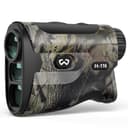
Published maximum ranges on these units run from 700 yards to 3,000. A blind hunter will use perhaps 60 of them. The maximum range figure is marketing on anything you shoot inside 200 yards, and it is worth paying attention to exactly once: when your blind looks across a cut cornfield or a canyon rim and you are shooting a rifle. Otherwise, trade range for precision. Our value pick publishes 500 yards on deer and 1-yard accuracy at 100 — the second number is the one that affects your shot.
Pay attention to minimum range instead, which almost nobody checks. A rangefinder that cannot read closer than six yards is fine; some cheap units struggle inside ten, which is a genuine problem if you are ranging the near edge of a shooting lane rather than the deer.
4. The missing accuracy figure is the finding
Name-brand optics publish accuracy tolerances: half a yard inside 125 yards, one yard at 100, two yards at 1,000. Budget rangefinders overwhelmingly do not — they publish a maximum range, a magnification and a list of modes, and quietly omit the one number that describes whether the readings are right. That omission is not proof a unit is bad. It is proof that nobody has committed to anything, which means the verification is your job.
Do it in the driveway, before the season. Pace off 20, 30 and 40 yards, range each one, and see whether the unit reads consistently within a yard. A budget rangefinder that passes that test is all a blind shot needs. One that reads 28 yards at 30 and 44 at 40 is a unit you found out about for free instead of over a deer.
5. Batteries, glass and one-handed use
Most hunting rangefinders run a CR2 coin cell, which is light and lasts but is not something you can source from a blind at 6 a.m. in December. Rechargeable units solve that and introduce the opposite failure: a flat battery because you forgot. Pick the one that matches how you actually manage gear, and if you take the coin cell, tape a spare inside the lid of your blind bag.
Magnification matters less than you would think — 5x or 6x is standard and plenty for ranging — but display type matters in low light. A red illuminated display reads at last light where a black LCD disappears into a dark deer. And test the unit one-handed with gloves on before you trust it: you will be holding a bow in the other hand.
How to actually use one from a blind
The mistake is treating a rangefinder as something you reach for when a deer appears. Lifting it, finding the animal in the eyepiece and pressing a button is three distinct movements behind a window, which is three more than a close deer will tolerate. Range landmarks instead, in the first ten minutes of the sit, before anything is out there.
Pick three or four objects you can identify instantly — a fence post, the near corner of a food plot, the broken-top tree at the end of the lane — range each one through the window you would actually shoot through, and write the numbers on a strip of tape stuck inside the blind wall. Then the shot is a comparison, not a measurement: the deer is just past the post, so it is thirty-four yards. That turns three movements into none.
Range through the window opening, not through mesh, and range the lane edges as well as the lane center — the clearance you care about is at the sides, where a frame or a limb is waiting. If you shoot a crossbow, do the same exercise with the bolt’s trajectory in mind and read shooting a crossbow from a ground blind for the rest-height and cocking issues that come with it. A shooting rest is the natural companion piece: ranged landmarks plus a steady rest is most of what separates a confident blind shot from a hopeful one.
Who does not need one
If every shot you take is inside 25 yards in thick timber, a rangefinder is a comfort rather than a necessity — at that distance, a pin gap covers the error and ranged landmarks from a single sit are enough forever, because the blind is not moving. If you hunt the same two setups all season, you can range them once and never carry the unit again. Where a rangefinder earns its place every time is open country, elevated blinds, crossbows and rifles reaching past a hundred yards, and any mobile setup where the landmarks are different every morning.
And one honest note about where your money does the most good: if you are choosing between a premium rangefinder and fixing the reason deer bust you, fix the busting. A $200 optic does not help a blind that was set in the wrong place. Our blind placement guide and the accessory kit priorities are the cheaper fixes, and they come first.