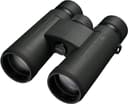
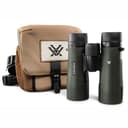
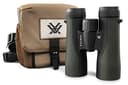
The three specs that decide a blind binocular
Every binocular on this page is waterproof, fogproof and rubber armored. Those features stopped being differentiators a decade ago. What still varies — and what makers publish, so you can check us — are these three.
1. Field of view: how fast you find the deer
Field of view is the width of what you see at 1,000 yards, and it is the spec that decides whether you get on an animal before it moves. The spread on this page is large: 456 feet for the compact 8x30, 377 feet for the 8x42, and 325 to 342 feet across the 10x42s. That is not a rounding difference. A deer steps out of a fencerow 120 yards from your blind; with a wide field you have it the moment the binocular hits your eyes, and with a narrow one you are panning, which takes seconds you may not have and movement you cannot afford inside a blind.
Magnification is the thing that eats field of view. Going from 8x to 10x in the same body always narrows the view, and in exchange you get detail you mostly do not need inside 150 yards. The honest rule: under 150 yards, buy the 8x; past 250 yards on open ground, buy the 10x. Between those, buy whichever you can hold steadier, which for most people is the 8x.
2. Eye relief: whether it works with glasses, a hood or a head net
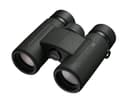
Eye relief is how far behind the eyepiece your eye can sit and still see the full image. Glasses push your eye back by roughly 10 to 12 mm before you start, so a 15 mm binocular is tight and a 20 mm one is comfortable. The Nikon P3 8x42 publishes 20.2 mm; every 10x42 on this page is at 15 to 17 mm. If you wear glasses, that single number should probably decide your purchase, and it is the reason our top pick is an 8x.
A hood and a head net push you back further still, which is the blind-specific version of the problem. If you hunt in the full head cover we recommend for concealment, try the binocular with the net on before you decide the short-eye-relief model is fine.
3. Exit pupil: the one that matters at dusk
Exit pupil is the diameter of the light column the binocular delivers to your eye, and it is simply the objective diameter divided by the magnification: 42 divided by 8 gives 5.3 mm, 42 divided by 10 gives 4.2 mm, 30 divided by 8 gives 3.8 mm. A human pupil opens to somewhere around 5 to 7 mm in the dark and less as you age. When your pupil is wider than the binocular’s exit pupil, the binocular is the bottleneck and the view goes dim.
This is why an 8x42 looks brighter at last light than a 10x42 made from the same glass, and why a 30 mm compact — however lovely in daylight — is the wrong tool for the twenty minutes when deer actually move. Nikon publishes exit pupil for both P3 models. Several makers do not, which is worth knowing when a binocular is sold on “low light performance” and the spec sheet will not say what that means.
8x or 10x for whitetails?
The default advice online is 10x42, and for a hunter glassing cut cornfields and long power lines it is good advice. For most whitetail hunting from a fixed position it is one notch too much magnification.
Three practical reasons. First, shake: 10x magnifies your pulse along with the deer, and bracing on a blind window sill is less steady than it feels. Second, field: the extra reach costs you about 50 feet of view at 1,000 yards, which is the width you need to catch movement. Third, light: that 1.1 mm of exit pupil is the difference between reading a rack at legal light and guessing.
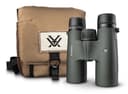
Buy the 10x anyway if your blind looks across an open field, a food plot of several hundred yards, or a river bottom where you are counting points before deciding to shoot. In that case the Diamondback HD is the pick, the Crossfire HD is the value version of the same idea, and the Leupold Timberline is the one that fits a small window.
Glassing from inside a blind: the practical part
The gear is only half of it. A blind changes how you use binoculars in ways nobody mentions when they sell you a pair.
Keep them on your chest, not on the shelf.A binocular on a shelf requires a reach, a lift and a turn — three movements inside a dark box with mesh windows a deer is already watching. On a chest harness it is one. Vortex includes the GlassPak harness with the Diamondback and Crossfire; the Nikons and the Leupold come with a neck strap and a case, so budget a harness separately if you pick those. Our blind bag guide covers where the rest of it should live.
Glass through the window opening, not the mesh. Shoot-through mesh is designed to be shot through, not looked through: it halves the contrast and the image goes flat and gray. Set one window fully open in your main shooting direction and glass through that one.
Brace, do not lean.Resting the objectives on a window sill transmits every shift of your body into the view and taps the frame. Press your elbows to your ribs instead, or run a tripod if the blind has room — the Leupold is the pick here because it has a 1/4-20 port in the hinge. The same logic applies to your gun: see gun rests for a deer blind.
Glass the thing you already saw, then glass what you did not. Most hunters only lift binoculars after spotting something. The habit worth building on a slow morning is a slow sweep of the edges every twenty minutes — brush lines, the dark under a cedar, the gap in the fence — because a bedded deer at 90 yards in cover is invisible to the naked eye and obvious through glass.
What you do not need to pay for
Rangefinding binoculars. They are excellent and they cost four to ten times what these do. From a fixed blind you can pre-range your lanes once with a handheld unit and write the yardages on the window frame. See whether you need a rangefinder at all and the rangefinder picks.
Camo finish.Deer are dichromats with poor red and orange discrimination; a black binocular inside a dark blind is invisible to them. What is visible is the glint off an objective lens in low sun, which a camo dip does not fix — shade or a window hood does.
Huge objectives. A 50 mm or 56 mm binocular genuinely gathers more light, and it also weighs 30 oz and does not fit a chest harness comfortably under a jacket. For the amount of time a blind hunter spends in true marginal light, the 42 mm is the better trade.
How we picked
We do not own units and we do not claim field tests we have not run. What we do is read the maker’s own published optical table for every candidate, reject anything that will not publish field of view and eye relief, confirm the listing is currently purchasable before it goes on the page, and then rank on the specs that match how a blind hunter actually glasses. Where a maker does not publish a figure — Leupold does not state exit pupil for the Timberline, for instance — the spec table says so instead of guessing. Our full method is in how we review gear.