Blind & Brush

Do You Need a Rangefinder for Bow Hunting?

From a blind the honest answer is that you need ranges — not necessarily a rangefinder in your hand at the moment of truth. How to get both, and what the specs actually have to do.

By Stephen V.Last updated How we pick

How this is funded: we earn a commission if you buy through our links, at no extra cost to you. It never changes which product we recommend, and we’ll tell you plainly when we’d skip one. Full disclosure.

If you hunt from a ground blind or a fixed stand, you need ranges— and you can have them without a rangefinder in your hand when the deer arrives. Range your shooting lanes when you set the blind, write the numbers on a strip of tape inside the window frame, and the shot becomes recognition instead of arithmetic: that is the fence post, that is 22 yards, that is my pin.

You still want to own one. You need it to do that marking, and you need it in hand if you hunt mobile, hunt from elevation, or sit ground you have never hunted before. The honest framing is that a rangefinder is a scouting and setup tool for a blind hunter, not a device you fumble for with a buck at 20 yards.

Why the shot-moment answer matters

Lifting a rangefinder at close range is the movement that gets hunters caught. Deer are built to catch exactly that: the peer-reviewed review of cervid visual ecology describes dichromatic vision with poor red and orange discrimination and eyes optimized for motion detection in low light. They are not studying your camo; they are watching for movement. Inside a blind the window is a frame around you, and a hand rising in that frame is the only moving thing in it.

So the goal is not “do I own a rangefinder” but “do I already know the distance to the spot that deer is standing in.” For a hunter who sits the same blind over the same field, the answer should be yes, every time, before the season starts.

The rangefinders that suit a bow

Three archery-relevant choices and one budget route. What matters for a bow is the minimumrange, the angle math and arrow clearance — not the 1,500-yard number on the box. Prices are live — check the “as of” stamp under each button.

Quick picks

Ranked on published specs, concealment fit and value. Select a row to jump to the full write-up. We have not field-tested this gear — here is exactly what we do instead.

#ProductBest forPrice
1
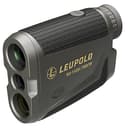
Leupold RX-1400i TBR/W Gen 2 with Flightpath

Leupold RX-1400i TBR/W Gen 2 with Flightpath

The one rangefinder here with a feature built for the exact problem a blind creates: Flightpath shows the highest point your arrow reaches on the way out, so you can tell whether it clears the window frame, the limb over the lane, or the brush you tucked the blind into. Everything else — 900 yards on deer, half-yard accuracy inside 125, a red display that reads at last light — is the Leupold baseline.

Best for bowhunters
$197.99 · View on Amazon

Price as of October 16, 2026. #ad How we’re funded

2
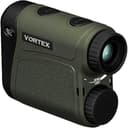
Vortex Denali 1000 Laser Rangefinder

Vortex Denali 1000 Laser Rangefinder

The value pick, and the one most blind hunters should actually buy. It publishes 500 yards on deer, 1-yard accuracy at 100, an HCD angle-compensated mode and a line-of-sight mode, in a 5.5-ounce body — every number that matters inside 200 yards and none of the ones that do not. The unconditional lifetime warranty is the quiet reason it outlasts cheaper units.

Best value for bow ranges
$149.99 · View on Amazon

Price as of October 16, 2026. #ad How we’re funded

3
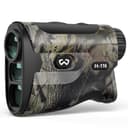
WOSPORTS 1500-Yard Hunting Rangefinder with Bow Mode

WOSPORTS 1500-Yard Hunting Rangefinder with Bow Mode

The cheapest unit here that publishes a bow mode and an angle reading, which are the two functions a blind hunter actually needs. At roughly a third of the Leupold's price it buys the right features; what it does not buy is a published accuracy tolerance, and that omission is the honest reason it sits at number four rather than number one.

Cheapest with a bow mode
$59.99 · View on Amazon

$99.9940% off

Price as of October 16, 2026. #ad How we’re funded

4
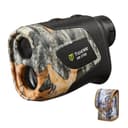
TIDEWE 700-Yard Rechargeable Hunting Rangefinder

TIDEWE 700-Yard Rechargeable Hunting Rangefinder

The pick for a hunter who hates coin cells, which is a more reasonable preference than it sounds — a CR2 that dies on a December morning is not replaceable from a blind. This one recharges, comes in camo, and publishes a 700-yard ceiling that is many times any shot you will take through a blind window.

Best if you hate coin cells
$69.99 · View on Amazon

$79.9913% off

Price as of October 16, 2026. #ad How we’re funded

#1Best for bowhuntersArchery-focused laser rangefinder

Leupold RX-1400i TBR/W Gen 2 with Flightpath

The one rangefinder here with a feature built for the exact problem a blind creates: Flightpath shows the highest point your arrow reaches on the way out, so you can tell whether it clears the window frame, the limb over the lane, or the brush you tucked the blind into. Everything else — 900 yards on deer, half-yard accuracy inside 125, a red display that reads at last light — is the Leupold baseline.

Strengths

  • Flightpath displays the arrow's peak height, which is the clearance question a blind window asks
  • Published 0.5-yard accuracy inside 125 yards — the band every bow and crossbow shot falls in
  • Red TOLED display with three brightness settings, readable at first and last light

Trade-offs

  • Bow Mode is published as accurate to about 70 yards and under 20 degrees of angle — fine for hunting, not for long-range work
  • Flightpath has to be calibrated to your bow's numbers before it means anything
  • The most expensive pick here, and a gun hunter shooting inside 200 yards will not use half of it
Magnification / objective5x / 21 mm
Max range (deer / trees / reflective)900 / 1200 / 1400 yd
Minimum range6 yd
Accuracy0.5 yd to 125 yd; 2 yd to 1000 yd
Angle compensationTBR/W plus Flightpath arrow apex
DisplayRed TOLED, 3 brightness settings
BatteryCR2, ~3000 actuations
Weight5.1 oz

The spec that matters. Flightpath is the spec worth paying for in a blind, because the shot you lose from a blind is rarely a range error — it is an arrow into a window frame or the one branch you never ranged. Leupold states Flightpath output is typical to roughly 70 yards depending on arrow characteristics.

Specs read from the product listing, on October 10, 2026. “Not published” means the maker does not state that figure.

#2Best value for bow rangesGeneral-purpose laser rangefinder

Vortex Denali 1000 Laser Rangefinder

The value pick, and the one most blind hunters should actually buy. It publishes 500 yards on deer, 1-yard accuracy at 100, an HCD angle-compensated mode and a line-of-sight mode, in a 5.5-ounce body — every number that matters inside 200 yards and none of the ones that do not. The unconditional lifetime warranty is the quiet reason it outlasts cheaper units.

Strengths

  • HCD mode gives the angle-compensated horizontal distance, which is the number you aim with
  • Published 1-yard accuracy at 100 yards — a real figure, which the budget picks do not print
  • VIP unlimited, unconditional lifetime warranty: dropped out of a blind window is still covered

Trade-offs

  • 500 yards on deer is the shortest reach of the name-brand picks — irrelevant in a blind, limiting in open country
  • No bow-specific apex or clearance feature, so there is no window-frame math
  • Vortex does not publish a battery life figure or an IP water rating for it
Magnification / objective6x / 20 mm
Max range (deer / trees / reflective)500 / 800 / 1000 yd
Accuracy1 yd at 100 yd
Angle compensationHCD and line-of-sight, +/- 60 degrees
Weight5.5 oz
BatteryCR2 included (life not stated)
Water resistanceWaterproof (no rating stated)
WarrantyVIP unlimited lifetime

The spec that matters. HCD is the setting to leave it on. From an elevated blind or a hillside, the line-of-sight distance is longer than the horizontal distance your arrow or bullet actually covers — the steeper the angle, the bigger the error, and holding for the slope reading is how a high miss happens.

Specs read from the product listing, on October 10, 2026. “Not published” means the maker does not state that figure.

#3Cheapest with a bow modeBudget laser rangefinder

WOSPORTS 1500-Yard Hunting Rangefinder with Bow Mode

The cheapest unit here that publishes a bow mode and an angle reading, which are the two functions a blind hunter actually needs. At roughly a third of the Leupold's price it buys the right features; what it does not buy is a published accuracy tolerance, and that omission is the honest reason it sits at number four rather than number one.

Strengths

  • Publishes a bow hunting mode plus distance, angle, speed and scan modes at a budget price
  • 6x magnification and a stated 1,500-yard ceiling, far beyond any blind shot
  • Cheap enough to keep a second one in the blind bag

Trade-offs

  • No published accuracy tolerance — the single most important rangefinder spec is missing
  • No published glass, coating or weather-sealing detail either
  • Budget rangefinders are where lifetime warranties are not, so treat it as replaceable
Magnification6x
Max range (stated)1500 yd
ModesBow hunting, distance, angle, speed, scan
AccuracyNot published
Water resistanceNot published
BatteryNot published

The spec that matters. Verify a budget rangefinder before you hunt with it: pace off 20, 30 and 40 yards in the yard and range each one. A unit that reads consistently within a yard at hunting distance is all a blind shot needs, and five minutes in the driveway is the only way to know.

Specs read from the product listing, on October 10, 2026. “Not published” means the maker does not state that figure.

#4Best if you hate coin cellsBudget laser rangefinder (rechargeable)

TIDEWE 700-Yard Rechargeable Hunting Rangefinder

The pick for a hunter who hates coin cells, which is a more reasonable preference than it sounds — a CR2 that dies on a December morning is not replaceable from a blind. This one recharges, comes in camo, and publishes a 700-yard ceiling that is many times any shot you will take through a blind window.

Strengths

  • Rechargeable battery: no CR2 to source in the dark on a cold morning
  • Camo body, which is one less dark rectangle moving behind a blind window
  • 700-yard stated range is far more than a blind hunter will ever use

Trade-offs

  • No published accuracy figure, the same gap as every budget unit here
  • Rechargeable also means it can be flat when you need it — charge it the night before
  • TIDEWE publishes no angle-compensation detail, so treat elevated-shot math as your job
Max range (stated)700 yd
PowerRechargeable
FinishCamo
AccuracyNot published
Angle compensationNot published
MagnificationNot published

The spec that matters. Rechargeable is the right trade for a hunter with a routine and the wrong one for a hunter who throws gear in a truck in October and finds it in November. Charge it the night before every hunt, or buy the coin-cell unit and keep a spare battery in the blind bag.

Specs read from the product listing, on October 10, 2026. “Not published” means the maker does not state that figure.

Pre-ranging: the ten minutes that replace a rangefinder

Do this when you set the blind, not in October.

1. Sit where you will hunt. Same chair, same height, same window. Ranges taken standing beside the blind are not the ranges you will shoot.

2. Range landmarks, not distances. You are not building a map; you are labeling objects. The fence post is 22. The forked oak is 31. The near corner of the food plot is 38. A deer will always be near something.

3. Write them down inside the blind. A strip of tape on the frame above the window. This is the whole trick, and it costs nothing.

4. Mark your limit.Put something at your honest maximum — a stick, a rock, a trimmed branch. Deer beyond it are not shots, and having that decided in advance is worth more than any optic.

Our blind setup guide puts this in the setup sequence, and quieting the blind is the other job to do on the same trip.

What the specs do, in plain language

Minimum range. The number almost nobody checks and the one that disqualifies units for archery. If a rangefinder cannot read a target at 10 yards, it cannot range half your bow shots. Leupold publishes a 6-yard minimum on the RX-1400i Gen 2; most budget units publish no minimum at all, which is itself worth knowing before you buy.

Accuracy at short range. At bow distances, a yard of error is a different pin. Leupold states 0.5-yard accuracy to 125 yards; Vortex states 1 yard at 100 yards on the Denali 1000. Both are fine for a bow; the point is that they state it, where the budget units in our rankings mostly do not.

Angle compensation.Needed from elevation, irrelevant at ground level. Leupold’s TBR/W and Vortex’s HCD both report the horizontal distance your arrow actually has to travel rather than the longer line-of-sight figure. Vortex publishes a plus or minus 60-degree maximum angle reading, which covers any treestand angle you should be shooting from.

Arrow clearance.The archery-specific feature most hunters have never heard of. Leupold’s Flightpath displays the highest point of your arrow’s flight once it is calibrated to your bow — which answers a question a bare range number cannot: will this arrow clear the branch over the lane, or the top of the window frame? From inside a blind, where you are shooting through a hole in a wall, that is the genuinely useful number.

Magnification. 5x or 6x is plenty, and more is a liability in a blind because it narrows your field of view. The job is identifying a landmark, not counting tines.

Where you do need one in your hand

Three situations where pre-ranging does not save you:

You hunt mobile. A saddle hunter in a new tree every sit has no pre-ranged lanes. Range from the platform once you are set, before light. Our shooting from a saddle guide covers the rest of that setup.

You hunt from elevation. The angle math is real, and it is easiest to get right with the device that does it for you.

You hunt somewhere with no landmarks.Standing corn, a clearcut, a swamp — places where everything looks the same at 25 and 45 yards. See standing corn for the worst version of this problem.

In all three, the rule is the same: range early, not late. Deer are dichromats with eyes built for detecting motion in low light rather than resolving detail — the peer-reviewed review of cervid visual ecology is clear on that — which means the slow hand movement of lifting a rangefinder when a deer is already at 20 yards is one of the most expensive things you can do in a blind. Get the number while he is still 100 yards out, or get it in September with a roll of tape.
Frequently asked questions

Do you need a rangefinder for bow hunting?

Not at the moment of the shot, if you hunt from a blind or a fixed stand — range your shooting lanes before season, mark them, and you will know the distance to every spot a deer can stand before it gets there. You do need one to do that marking, and you need it in hand if you hunt mobile, spot-and-stalk, or on ground you have never sat before. Budget for a rangefinder as a scouting tool rather than as something you fumble for with a deer at 20 yards.

What rangefinder features actually matter for a bow?

Minimum range, angle compensation and arrow clearance. Bow shots happen between 10 and 40 yards, so a unit that will not read closer than 10 yards is useless to you — the Leupold RX-1400i Gen 2 publishes a 6-yard minimum and 0.5-yard accuracy inside 125 yards. Angle compensation matters from any elevated position, and Leupold's Flightpath goes further by displaying the highest point of the arrow's flight once it is calibrated to your bow, which is a clearance tool rather than a ranging one.

Is angle compensation worth it for bow hunting?

From an elevated stand, yes. Shooting down at a steep angle, the line-of-sight distance to the deer is longer than the horizontal distance your arrow actually has to cover, and shooting the line-of-sight number puts the arrow high. Angle-compensating modes give you the shorter number to aim for — Leupold calls its version TBR/W, Vortex calls its Horizontal Component Distance and publishes a plus or minus 60-degree maximum angle reading. Inside a ground blind at ground level, the angle is trivial and this feature does nothing for you.

Can you use a golf rangefinder for bow hunting?

It will give you a number, and for flat-ground blind hunting that number is usable. Two cautions: golf units are built to lock onto the nearest reflective target (a flagstick) rather than onto a deer-sized object in brush, and most do not offer the angle-compensating mode that matters from an elevated stand. A hunting unit with a 6 to 10 yard minimum and an angle mode is a better tool for the job.

How do you range shooting lanes from a ground blind before season?

Sit in the chair you will hunt from, at the window you will shoot through, and range every object a deer can stand next to — the fence post, the trail junction, the big oak, the field corner. Write the numbers on a strip of tape inside the blind. Now your shot decision is recognition rather than arithmetic, which is the entire point: a hunter raising a rangefinder at 20 yards is making exactly the movement a deer is built to catch.

Sources

Keep reading