What “portable” actually means in this category
Every blind here folds into a bag one person can lift. That is not the useful distinction. These four things are, in the order they decide whether a blind ends up where you wanted it:
- Published packed weight. The real spread on this page is 9 lb to 15 lb. Six pounds sounds trivial written down and is the whole argument at the end of a half-mile walk with a bow, a pack and a chair. Only five of the eight conventional blinds in this registry publish a packed weight at all, and all five are on this page.
- Carry format. A backpack with two straps and a duffel with one handle are different products at the same weight. Ameristep publishes a backpack with the Outhouse and the SPUR Collector ships with a bag; backpack-style carry is the single biggest comfort difference on a long walk-in, and it is the spec most listings mention only in passing.
- Setup time, in the dark, alone. Published setup figures here run from 30 seconds (the Tent Chair Blind) to under two minutes (the SPUR Collector) to nothing published at all. A blind you can pop, stake and sit in inside two minutes is a blind you can move at midday when the wind swings; a blind that takes ten is a blind you leave where it is and hunt a wrong wind.
- What the weight costs you. Floor area and capacity, in that order. A 60 x 60 in. blind published for one hunter and a 75 x 75 in. blind published for two are six pounds and 2,025 square inches apart. Decide which of those numbers you are actually short of.
What does not belong in a portability ranking is price. The lightest blind here is near the bottom of the price range and the heaviest is at the top, which is the opposite of how portability usually gets sold. If a hard budget is the constraint rather than the walk, read best ground blinds under $200 instead — it ranks the same category against a live-checked price cap.
The weight ladder, and what each step buys
Lined up by published weight, the picks on this page read as a single ladder, and the trade is legible at every rung:
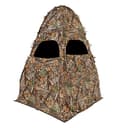
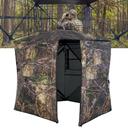
- 9 lb — Ameristep Outhouse. 60 x 60 in. floor, a published 78 in. of height, one hunter, four zippered windows with shoot-through mesh and gun ports, backpack included. The lightest and the tallest, and the only one here you can stand up in to shoot.
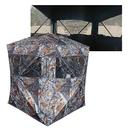
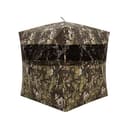
- 10.6 lb — THUNDERBAY SPUR Collector. 50 x 50 in. packed footprint (63 x 63 in. set up), 60 in. height, five hubs, 270 degrees of silent sliding windows with shoot-through mesh covers, 210D polyester. The cheapest real hub blind, and the shortest.
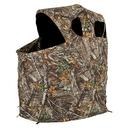
- 12.9 lb — Ameristep Tent Chair Blind. The seat is the blind, so the 12.9 lb replaces both a blind and the chair you would have carried. Published 30-second setup. Ameristep publishes it for firearm and crossbow hunters, not for a vertical bow.
- 13.5 lb — Ameristep Care Taker. 55 x 65 in. floor, 65 in. height, published shoot-through mesh windows. The lightest blind here a bowhunter can draw inside behind cover.
- 14.7 lb listed — Mossy Oak 360-degree see-through. One-way mesh on all four walls, exterior brush-in loops, three doors, a published sub-minute pop-up. The lightest route to see-through walls.
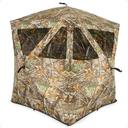
- 15 lb — Barronett Ace 250.75 x 75 in. floor, 67 in. height, HD 150 denier, a silent panoramic front window and detachable blaze-orange panels. Half as much floor again as the Outhouse — 2,025 more square inches — for six extra pounds.
Read the two ends of the ladder together. Six pounds buys 2,025 more square inches of floor — 3,600 against 5,625 — which is the difference between a blind published for one hunter and a blind published for two. That is a genuinely good deal if you drive to within a hundred yards of the spot, and a bad one if you do not. And note what it does not buy: the heavier blind is eleven inches shorter, so you gain a floor and give up the ability to stand.
The published gap: item weight is not packed weight
This page has to make a distinction most roundups quietly skip. Five of these six blinds have a weight the maker publishes in its own specification text. The sixth has only Amazon’s item-weight field, and those are not the same claim. An item-weight field is retail logistics data; a published packed weight is a number the maker stands behind. We label them differently in the spec tables above, and on this page we only call a figure “published” when the maker published it.
Where that distinction bites hardest is the blinds we did notput on this page. The Primos Full Frontal’s listing carries an item weight of 8.45 lb, which would make it the lightest blind in this registry. It also carries a published package length of 42 inches for a blind with a huge interior, and those two figures do not describe the same object. We treat that weight as unusable rather than publish the lowest number we found, and the Primos is ranked instead in best see-through ground blinds, where its front wall is the point. The THUNDERBAY Gobbler Lodge publishes no weight at all, which for the largest blind we track is the figure you most want before agreeing to carry it anywhere.
Which of these six is yours
If you are walking more than half a mile
The Outhouse, and nothing else here is close. Nine pounds with a backpack is the only setup on this page that does not change how you pack the rest of your gear. Accept up front that it is a one-hunter blind: a 60-inch-square floor holds you, a chair and a pack, and that is the end of the list. Our full packing logic is in how to pack a blind bag.
If you shoot a bow
Height and shoot-through mesh decide it, and that narrows the page to two. The Outhouse publishes 78 inches of height and shoot-through mesh on all four windows, which is the only combination here that lets a tall hunter draw standing. The Care Taker publishes shoot-through mesh at 13.5 lb and 65 inches of height, which is a seated draw for most people. Avoid the 60-inch SPUR Collector if you intend to draw on your feet, and skip the Tent Chair Blind entirely — Ameristep publishes it for firearms and crossbows. The shot mechanics are in how to shoot a bow from a ground blind, and the wider lineup is in best ground blind for bow hunting.
If you are moving every sit
The Tent Chair Blind. A published 30-second deployment and no separate chair is the fastest concealment in this registry, and the reason to accept that you cannot stand up or swap seats inside it. This is the blind for hunting ground you did not plan on — a fresh scrape, a cut cornfield, a wind that turned. It is not the blind to own if you only own one.
If you want to see deer before they see the blind
The Mossy Oak 360. It is the lightest see-through blind we can verify, and the published exterior brush-in loops matter more on a see-through shell than on a solid one, because a four-wall mesh blind gives a deer more surface to read, not less. Whether see-through walls are the right trade at all is argued out in are see-through ground blinds worth it.
If “portable” means “out of the truck bed”
The Barronett Ace 250, and stop optimizing for weight. At 15 lb you get 75 x 75 inches of floor, 67 inches of height, a published 150-denier shell and detachable blaze-orange panels. A hundred-yard carry does not care about six pounds, and the floor area changes how long you can sit still.
The weight you forget to count
A blind’s published weight is the bag, not the setup. Four things ride along with it, and together they usually weigh more than the difference between any two blinds on this page:
- Stakes and guy lines.The ones in the box are usually thin aluminum pins that pull out of soft ground, and a staked blind is the difference between a blind and a kite. Real ones are heavier and worth it — best ground blind stakes.
- A chair. Two to eight pounds depending on what you buy, and the single reason the Tent Chair Blind competes on weight at all. See best ground blind chairs.
- Something for the floor.Dry leaves inside a blind undo a silent window instantly. A mat is a pound or two; clearing the floor by hand before you set the blind is free — best ground blind flooring.
- Brush, which weighs nothing and matters most.A brushed-in 9 lb blind out-hunts a bare 15 lb blind every time. Cut it from off to the side of your shooting lanes, not from them — how to brush in a ground blind.
The portable-blind rule nobody reads until they are cited
A portable blind is usually a public-land blind, and public land is where blind regulations are strictest. Two examples of how different they get: Minnesota law requires a fabric or synthetic ground blind used for deer on public land to carry blaze orange on top visible for 360 degrees, or at least 144 square inches of blaze orange on each side. Wisconsin’s DNR requires 144 square inches of solid blaze orange or fluorescent pink visible from all directions during firearm deer seasons on DNR-controlled land — andthe owner’s DNR customer ID or name and address on a blind left unoccupied.
That second clause is a quiet argument for carrying the blind out. A blind that goes home in a backpack every evening is never an unoccupied blind, never needs a name tag on it, and cannot be moved, damaged or claimed by anyone else. The Barronett is the only pick here that ships detachable blaze-orange panels; everywhere else you are buying or sewing them. Check your own state’s regulation before gun season, and read how to hunt public land for the rest of the public-ground playbook.
What we left out, and why
Anything we could not verify a live offer for. Every pick on this page was confirmed with a live Amazon offer on the day it was published. A dead listing is worse than no recommendation.
Blinds with no published weight. A portability ranking built on estimated weights is not a ranking, it is a guess with a table around it. The Gobbler Lodge and the Primos are both covered in best ground blinds, which sorts the whole category on specs rather than on carry.
Natural blinds.The most portable blind is the one you do not carry, because it grows where you hunt. It conceals better than anything on this page, costs nothing, and cannot be moved once built — how to build a natural ground blind.
Tree saddles and mobile elevated setups.They solve the same problem — concealment you carry — from a completely different direction, and a full saddle setup weighs more than any blind here once you add sticks. The comparison is in saddle vs ground blind.