The three shooting positions that work
1. Standing, forend braced on the trunk — the best one
Stand flat-footed on the platform, settle your weight back into the bridge so the saddle carries you rather than your legs, and brace the forend of the rifle against the trunk or a solid limb with the back of your support hand as the padding. This is as close to a bench as a tree gets. It works in the arc facing the tree and about 45 degrees either side, which is why choosing the tree is a shooting decision rather than a convenience one.
2. Leaning out on the bridge, sling-tensioned
For shots to the side or behind the tree, rotate around the trunk, let the bridge take your weight fully, and wrap your support arm through the sling to pull the rifle into your shoulder. The sling is what makes this position steady; without it you are holding the gun up with an arm that is also doing balance work. Practise this one at ground level until the sling wrap is automatic, because fumbling it with a deer in the open is the whole failure mode.
3. Seated into the panel, knee-braced
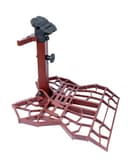
Lowest and steadiest of the three, but it limits your arc badly and is slow to get into. Use it for a shot you can see developing — a deer working a trail toward you — rather than as a default. Drop your weight fully into the panel, bring one knee up against the trunk, and rest the forend across it.
In all three the principle is the same, and it is the opposite of bowhunting: the saddle holds you so your arms can hold the rifle. A bowhunter uses the saddle for freedom of movement. A gun hunter uses it for stillness. Our shooting from a tree saddle guide covers the bow version, and the contrast between the two is worth reading side by side.
Where the rifle lives, and how it gets up the tree
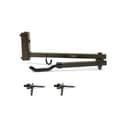
Haul it, never carry it. Climb attached and empty-handed, get your tether set and your weight in the saddle, then pull the rifle up on a rope with the muzzle down and the action empty and open. A screw-in hanger with an accessory hook puts it within a slow arm’s reach so you never have to twist or reach across your body — which is both a safety point and a concealment one, since the big reach is exactly the movement a deer catches.
One legal caveat on the hanger: screw-in hardware is not legal on a great deal of public land, and the listing says so. On public ground use a strap-based hook instead. Our bow holder and gear hook picks cover both styles.
Keep the sling on the gun. Hunters strip slings off for bow-style mobility and then have nothing to tension a shot with, nothing to secure the rifle to the hanger with, and nothing to carry it with on the walk out. A sling is the cheapest accuracy accessory in gun hunting.
Safety, stated plainly
A saddle is a fall-arrest system when it is rigged correctly, and nothing at all when it is not. Add a firearm and the margin for casual rigging goes to zero.
The agency numbers are worth keeping in mind every time you are tempted to climb the first ten feet unattached. Wisconsin’s DNR guidance is to always wear a full-body harness or fall-arrest system, and notes that roughly one in four bowhunters have fallen or nearly fallen. The Tree Stand Safety Awareness Foundation cites a ten-state study in which 99 percent of fall victims were not attached to the tree and 86 percent wore no harness. Those are not cautionary statistics about equipment failure — they are statistics about people who were not clipped in.
Three rules, specific to the rifle version:
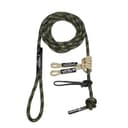
Attached from the ground up.Lineman’s belt on before your boot leaves the dirt, tether set before you unclip anything. The rope set in our picks publishes a 440 lb safe working load and a 4,420 lb minimum breaking strength on the sewn eye, and covers both the tether and the lineman’s belt roles. How to use a lineman’s belt is the method.
Firearm empty until you are settled, empty before you descend. Load after the rifle is hauled up, you are tethered, and you have found your shooting positions. Unload before you touch the hanger on the way out.
Know your descent before dark. Coming down in the dark with a firearm is the part of the hunt most likely to hurt you. How to descend safely and saddle hunting safety tips cover it, and safety harnesses is the page to read if you are not yet convinced a saddle counts as one.
Gun season adds blaze orange, and that is fine
Firearm seasons bring clothing requirements a bowhunter never thinks about, and they vary. Texas requires 400 square inches of hunter orange plus orange headgear on public land during firearm seasons. Virginia has its own blaze orange or fluorescent pink requirement during firearms deer season. Read your own regulations — the numbers differ state to state and the obligation does not.
The good news is that the research says this costs you less than hunters fear. Peer-reviewed work on cervid visual ecology describes deer as dichromats, sensitive to short blue wavelengths and poor at the red and orange end of the spectrum, which is why blaze orange reads as muted to a deer rather than glowing. What they areexcellent at is detecting movement and outline — so the thing to manage in a saddle is your silhouette against the sky, not the colour of your vest. Can deer see blaze orange goes through the studies, and how to conceal in a tree stand deals with the silhouette problem.
When to leave the saddle at home
Be honest about the hunt. A saddle is for mobility — a tree you picked off a map, a morning sit, and gone. If your gun hunt is a six-hour sit on a cut cornfield waiting for a 200-yard shot, you want a rest you cannot get in a tree, a roof over you and room for a chair. That is a blind, and it is not a compromise: saddle vs ground blind works the decision through properly, and rifle blind picks covers the alternative.
Most gun hunters who try this end up running both: the saddle for the early-season mobile hunts and the pressured public-land mornings, the blind for the late-season field sits. Mobile vs fixed hunting is the framework, and how to pack for a mobile hunt is the packing list with a rifle added.