Why a crossbow needs a different rest
The weight is in the wrong place
A crossbow’s riser, limbs and cams all sit forward of the trigger, so the bow wants to nose over. On a rifle you can rest the fore-end wherever it balances; on a crossbow, a rest placed too far forward puts your support under the limbs and a rest placed too far back lets the muzzle end dive. The practical answer is a rest that takes the load under the fore-grip area of the stockand holds its angle without you fighting it — which is what a clamp does by definition and what a V-yoke does only if you keep a hand on the bow.
The limbs must touch nothing
This is the one that bites people. Every crossbow manual prints the same rule in some form: keep your fingers and thumb below the flight deck, keep every part of you out of the path of the string and cables, and keep the limbs clear. Read your own model’s manual rather than a forum post, because widths differ. A narrow cradle that works beautifully under a rifle fore-end can sit right where a crossbow’s limb travels, and the window sill of a hub blind is the single most common offender — it is the wrong height, it is rarely level, and it puts fabric and frame inside the limb arc.
You are sitting down
Most crossbow shots from a blind are taken from a chair, which means the rest has to work in a 30-inch band between your knees and your shoulders, be adjustable with one hand, and not require you to stand up and silhouette yourself in a window. Height range matters more than maximum height. None of the tripods here publishes a height range, which is worth knowing before you order: measure from your blind floor to your seated shoulder and check the listing’s own dimensions before you commit.
What to look for, in order
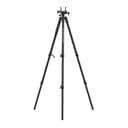
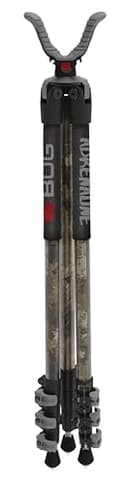
1. Does it hold the bow without you?A clamp does. A yoke does not. If your sits are long and cold, this is the feature that changes the hunt, because the alternative is holding eight pounds up at the moment a deer steps out — the exact moment you can least afford to move. Deer are built to catch that movement: the peer-reviewed review of cervid visual ecology describes eyes tuned for motion detection in low light rather than for fine detail, which is why a hunter who has to lift and settle a crossbow gets busted and a hunter whose crossbow is already pointed does not.
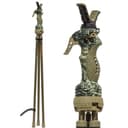
2. Can you adjust it with one hand, quietly? Trigger-adjust legs are the reason the Primos sticks have outsold everything else for a decade. A rest you adjust by twisting two plastic collars is a rest you will not adjust when it counts.
3. Does the head let the bow level itself? Blind floors are not level, mats bunch, and a tripod leg finds the one dip in the ground. Cant in the bow is cant in the arrow.
4. Footprint.A tripod inside a hub blind competes with your chair, your pack and your feet. If your blind is a two-person hub with a heater in it, measure before you buy — our blind sizing guide has the real interior numbers.
What does not work, and why
A sling-stud bipod. The Caldwell-style bipod in our bipod vs tripod comparison attaches to a rifle’s forward sling stud and sits six to nine inches off the ground. Crossbows generally do not have that stud in that place, the height is wrong for a seated shot, and the mount puts hardware inside the limb sweep. It is a good rest on the wrong weapon.
The blind’s own window sill. Free, always there, and the worst rest in the blind: wrong height, never level, fabric that creeps, and a frame tube sitting exactly where a limb wants to travel. Rest the bow on a rest, and use the sill for your elbow if you want a second contact point.
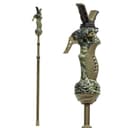
A monopod, if you are hunting all day. The monopod is on this page because it is genuinely the right answer for a mobile hunter who carries the rest and uses it for ten seconds. It is not a rest you can take your hands off, and over a six-hour sit that is the whole ballgame.
Two things to sort out before season
Shoot off the rest you will hunt off. A crossbow grouped from a bench and a crossbow grouped from a tripod at seated height are two different zeroes. Set the rest at the height your chair actually puts you, shoot it from the chair, and leave the rest set there. Our guide to shooting a crossbow from a ground blind walks through the window geometry and the cocking problem in a confined space.
Check the blind rules for the season you are hunting. Crossbow seasons often overlap firearm seasons, and in those seasons the blind itself can be regulated. Minnesota requires a fabric or synthetic ground blind used for deer on public land to carry blaze orange on top visible for 360 degrees orat least 144 square inches on each side. Wisconsin requires 144 square inches of solid blaze orange or fluorescent pink visible from all directions during firearm deer seasons on DNR-controlled land, plus owner identification on an unoccupied blind. Those are two states’ rules, not a national standard — read your own, and see our blaze orange picks for the cheap fix.