The short answer
If you are going to shoot an animal with it, buy the hunting rangefinder. Not because the laser is better — it usually is not — but because the software picks a different target and does different arithmetic with an angle, and both of those differences work against you in the woods.
If you already own a golf rangefinder, do not rush out to replace it. For a gun hunter in a ground blind on flat ground, a golf unit will do the job all season with one adjustment to how you use it: range the ground the deer is standing on, not the deer. The reason that works is the whole point of this page.
If you bowhunt, buy the hunting unit. Short ranges, published minimum range and arrow-clearance arithmetic are three things golf units are not built to do and mostly do not publish.
The real difference is target priority, not the laser
Here is the mechanical heart of it, in the manufacturer’s own words rather than a forum’s. Nikon publishes a Target Priority Switch System with two modes. First Target Priority mode“allows you to measure the distance of the closest subject” and, Nikon says, is “useful when measuring the distance to a subject in front of an overlapping background.” Distant Target Priority mode“displays that of the farthest subject,” for wooded terrain where the subject “may be partly obscured by bushes and undergrowth.”
Read those two sentences as descriptions of two sports and the whole category makes sense.
A golfer stands on a fairway and ranges a flagstick with a tree line a hundred yards behind it. The flag is the nearest object worth reading, so the unit should ignore everything beyond it. First target priority is correct, and golf makers go further, adding a flag-lock confirmation and a vibration pulse so you know the laser caught the pin rather than the trees.
A hunter sits in a blind and ranges a deer standing behind a screen of saplings, head-high grass or the brush he piled around the blind himself. The animal is thefarther object. A unit tuned to grab the nearest reflective thing will happily hand you the range to the brush at twelve yards while the deer stands at thirty-four. Distant target priority is correct, and that is why hunting units default to it.
The practical workaround, if you own a golf unit:do not range the deer. Range the fence post, the trail junction, the big oak and the field corner before daylight, write the numbers on a strip of tape inside the window frame, and your shot becomes recognition rather than arithmetic. That is better practice than ranging a live animal anyway — raising an optic at thirty yards is exactly the movement a whitetail is built to catch, which the bow-hunting rangefinder guide goes through in detail.
Slope and angle compensation are the same math with different rules
This is the part most comparisons get backwards, and it is genuinely interesting: the single most useful rangefinder feature for a hunter is the one golf’s own rule book prohibits.
The Rules of Golf, Rule 4.3a(1), allows “Getting information on distance or direction (such as from a distance-measuring device or compass).” Under Not Allowedit lists “Measuring elevation changes” and “Interpreting distance or directional information (such as using a device to get a recommended line of play or club selection).” That is why a golf rangefinder’s slope mode is a switchable, often physically lockable extra with an external indicator: the device may have the capability, but a player who uses it has breached the rule.
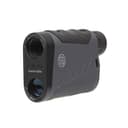
In hunting, nothing bans it, so the same arithmetic is the headline feature and every maker names it differently. Leupold calls it TBR/W, Vortex calls it HCD, SIG calls it AMR. All three convert a line-of-sight reading into the horizontal distance your arrow or bullet actually has to cover. SIG works the example in its own manual: a 500-yard line-of-sight reading at a 30-degree decline is 433 yards of horizontal distance. Hold for the 500 and you shoot high.
So the honest conclusion is not “hunting units have a feature golf units lack.” Many golf units have slope. It is that a golf unit was designed to make that feature easy to disable, and a hunting unit was designed to leave it on and label it for ballistics. If you buy a golf unit for hunting, make sure its slope mode is one you can switch on, and know that from a raised box blind you will want it.
Minimum range, and why bowhunters cannot ignore it
A golf rangefinder is built for 90 to 250 yards. A bowhunter in a blind is working between 15 and 40. That is the opposite end of the instrument, and it is where the published specs separate.
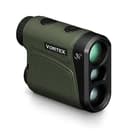
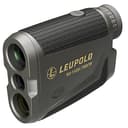
Leupold publishes a 6-yard minimum range on the RX-1400i and 0.5-yard accuracy inside 125 yards— the exact band every bow and crossbow shot falls in. Vortex publishes 1-yard accuracy at 100 yards for the Denali 1000. Those are real figures a buyer can compare.
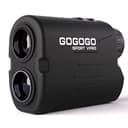
Most budget dual-purpose units publish neither. The Gogogo GS03 above publishes a 1,000-yard ceiling, 6x magnification, a slope mode and flag-lock to 300 yards — and no accuracy tolerance at all. That omission is why it sits last on this page rather than first: it has the right features and no stated precision, and on a twelve-yard archery shot precision is the only thing that matters. The site’s rangefinder roundupmakes the same point about every budget unit in the category — the missing accuracy figure is the pattern, not an exception.
There is a free way to settle it on any unit, golf or hunting: pace off 20, 30 and 40 yards in the yard and range each one. A rangefinder that reads consistently within a yard at hunting distance is all a blind shot needs, and five minutes in the driveway is the only way to know whether yours does.
The arrow-clearance feature no golf unit has
One hunting feature has no golf equivalent at all, because golf has no equivalent problem. Leupold’s Flightpath displays the highest point your arrow reaches on the way to the target, calibrated to your bow’s own numbers.
That is the question a blind actually asks. The shot you lose from a ground blind is rarely a range error — it is an arrow into the top of the window frame, into the limb over the shooting lane, or into the brush you piled around the blind in August. A range number does not tell you whether the arrow clears those. An apex height does. Leupold states Flightpath output is typical to roughly 70 yards depending on arrow characteristics, which is far past any blind shot.
If you shoot a bow or a crossbow through a window, that feature alone is a reasonable argument for a hunting unit regardless of what is in your golf bag. The alternative is doing it by eye, which is what shooting a bow from a ground blind covers: kneel in the chair, draw at the window, and have somebody watch the arrow path before the season rather than during it.
What a golf unit genuinely does better
Three things, and it is worth saying them plainly rather than pretending the hunting version wins everywhere.
Flag-lock with a vibration pulse. A tactile confirmation that the laser hit the small thing you aimed at is genuinely useful, and hunting units mostly do not have it. On a field-edge blind ranging a single fence post at 180 yards, it is a nicer experience.
Scan speed and display clarity on small targets. Golf units are optimized to lock a 1.5-inch pin at 200 yards, which is a harder target than a deer. That tuning shows.
Price. The dual-purpose market is competitive and the budget units are cheap. If the alternative is hunting with no rangefinder because a premium unit is out of budget, the dual-purpose unit is the right buy, with the caveats above.
So which should you buy?
Bowhunter or crossbow hunter: hunting unit, and specifically one that publishes a minimum range and an accuracy tolerance. The arrow-clearance feature is a bonus, not the reason.
Gun hunter in a ground-level blind on flat ground: whatever you already own. Pre-range the lanes, write the numbers on tape, and the target-priority problem disappears because you are ranging dirt and fence posts, not deer.
Gun hunter in a tower or box blind, or on hills: something with angle compensation, hunting-labeled or a golf unit whose slope mode you can switch on. The steeper the angle, the more it matters.
Open country, 300 yards and out: a hunting unit with published reach and resolution. This is the one case where the extra money buys capability you will actually use.
You golf and you hunt and you want one device:buy the dual-purpose unit with your eyes open. Verify it in the driveway at 20, 30 and 40 yards before you hunt with it, and remember flag-lock is the wrong instinct in brush — so range the ground, not the animal.