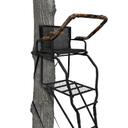
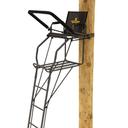
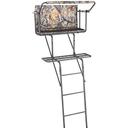
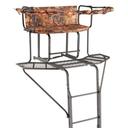
How we ranked these, and what we refused to rank on
Every figure on this page came off the listing or the maker’s own published feature data on the date stamped under each product. We own none of these stands and have hung none of them, so there is no “we tested it” claim anywhere here. What we can do is read what each maker chose to publish — and, more usefully, notice what they all left out.
The four specs that decide a ladder stand, in the order they matter:
- Rated capacity, read as a budget.A 300 lb rating is not a bodyweight limit — it is hunter plus boots plus December layers plus rifle plus pack plus thermos, all at once. A 220 lb hunter dressed for a late-season sit is closer to 300 than he thinks. Four of the five stands here publish a capacity; the Rivers Edge, which is otherwise the best-specified stand on the page, publishes none at all.
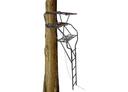
- Platform depth, not platform width. Width gets advertised; depth decides whether you can stand with both feet flat and your weight over the tree, or whether you are perched on a shelf leaning on a rail. The spread here is enormous: 27 inches deep on the Rivers Edge against 12 inches on both two-man stands. Twelve inches is a shelf.
- Whether a fall-arrest system is in the box.Two of these stands publish one included (the Big Game, and the Guide Gear 20-footer with two). Three say nothing, which you should read as “no.” A harness is not an upsell on a ladder stand; it is the difference between a fall and a funeral.
- Stand weight, where it is published at all.These are 73 to 107 lb assemblies that arrive in a box and have to be walked, raised and strapped. Big Game publishes no stand weight. Guide Gear publishes two different numbers for the same 16.5-foot stand — 76 lb in its feature text and 80.3 lb in its shipping data. Trophy publishes an 84 lb shipping weight and no stand weight.
We did not rank on brand reputation, on “comfort” as a feeling, or on seat padding, because none of those is a published figure. And we did not rank on height, which is the number this category advertises hardest and the one that matters least — for reasons below.
The certification gap nobody mentions
Ladder stands are sold on the implication of safety testing. The Treestand Manufacturers Association publishes the actual standards its member products are tested against — ASTM F3249 for treestands, climbing sticks and tower stands, F3545 for static loading, F2337 for fall-arrest systems, F2128 for repetitive loading — and states that its manufacturing members must submit products to a third-party testing firm and have been required to comply with current ASTM standards since January 1, 2016.
Here is the finding. Exactly one of the five stands on this page says anything about that on its own listing. The Rivers Edge Retreat LS publishes “This product meets ASTM standards recognized by TMA.” The Big Game, both Guide Gear stands and the Trophy publish no compliance statement at all. That does not prove they are untested — a maker can be a TMA member and simply not repeat it in a bullet — but it does mean the buyer has no published basis for the assumption, which is worth knowing before you climb. TMA itself publishes no numeric load requirement either, so a stand’s own rated capacity remains the only capacity figure you ever get.
Why a ladder stand is a concealment problem first
This site exists because hunters get busted, not because they lack gear. A ladder stand is the clearest example of a purchase that solves one problem and creates another.
What it solves: a fixed, stable, comfortable platform that the same hunter can climb in the dark, in the rain, at 5 a.m., in heavy clothes, every time, without the skill a climber or a tree saddle demands. If you hunt the same farm all season and you want to sit from dark to dark, nothing beats it. That is why ladder stands outsell every other elevated option.
What it creates: a human-shaped silhouette on an open bench with sky behind it. Deer are dichromats with excellent motion detection and poor detail resolution — they are built to notice a shape that moves against a bright background, which is precisely what a hunter raising a rifle on a bare ladder stand is. Your fixes, in order of cost:
- Put cover behind you, not just around you. Hang the stand against a trunk with limbs above and a second tree or a thicket behind it. A stand on a lone field-edge tree is a billboard.
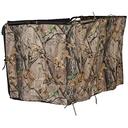
- Add a blind kit. The Muddy kit above publishes a 32 x 100 in. three-quarter surround that hook-and-loops onto most stands with a shooting rail. Run it on the downwind and approach sides first, because that is where the movement gets seen.
- Or buy the stand that includes one. The Guide Gear 20-footer unfolds its padded shooting rail into a wrap-around blind. That is the only stand here that ships concealment with the steel.
- Brush it in and leave it alone.Everything we say about brushing in a ground blind applies at height — camo netting for tree stands covers the full method, including skirting the lower rails first rather than screening at chest height.
How high is high enough
Sixteen to eighteen feet does everything you need in most whitetail timber: it lifts your outline out of a deer’s normal browsing eyeline, it buys a little margin on scent, and it keeps your shot angle sane. Twenty feet buys very little extra concealment and costs you three things: a steeper shot angle that shrinks the vitals a bowhunter can reach, more exposure to sky, and a longer fall.
The height-versus-scent argument is also weaker than it is usually sold. Elevation does not remove your scent; it changes where the plume lands. Thermals pull it downhill in the evening and lift it in the morning regardless of how high you sit, which is why our thermals guide matters more to a stand hunter than another five feet of ladder. Pick height for shot angle and cover, then play the wind.
Ladder stand or something else
Ladder stand vs hang-on
A hang-on plus sticks weighs a third of what these stands weigh and can be moved when the deer move; a ladder stand is a decision you make once per tree. The full trade-off, including who should own each, is in ladder stand vs hang-on.
Ladder stand vs saddle
A saddle setup is the opposite philosophy: carry everything, hunt any tree, weigh under ten pounds, and accept that comfort takes practice. If you are choosing between a fixed stand on your own ground and a mobile kit for public land, read mobile vs fixed hunting before you buy either.
Ladder stand vs ground blind
A ground blind beats a ladder stand on concealment, on taking a child along, on rain and cold, and on terrain with no climbable tree — and loses on sightlines and on scent. The honest comparison is ground blind vs tree stand, and if the answer turns out to be the blind, start at best ground blinds under $200.
Buy these with it, and hang it the boring way
A ladder stand is not a complete purchase. Budget for a full-body harness whether or not the box includes one — our picks are in best safety harnesses— and for a lineman’s rope if you intend to work on the stand at height, which is covered in best lineman’s ropes. State wildlife agencies are blunt about why: Wisconsin’s DNR notes that roughly one in four bowhunters has fallen or nearly fallen, and the Tree Stand Safety Awareness Foundation cites a ten-state study in which 99% of fall victims were not attached to the tree and 86% wore no harness at all.
Then hang it the dull, correct way:
- Three people, or a winch, never two. These are 73 to 107 lb assemblies. The raise is the most dangerous five minutes of the season.
- Pick a straight trunk with no lean toward you. A back-leaning tree loads the ratchet strap in the wrong direction.
- Ratchet from the ground where the design allows it. The Rivers Edge publishes exactly this as its Lockdown system, and it is the right idea regardless of brand.
- Hang it in the off-season and leave it. Deer forgive new hardware given weeks, not days. A stand hung in July is furniture by November; a stand hung last Friday is a new object in their living room.
- Inspect straps every single year. Webbing left on a tree through a summer of UV is the failure point in most ladder-stand accidents, and it is the cheapest part to replace.
What we left out, and why
Stands over $500. The Rivers Edge Lockdown 21-foot two-man sits in our wider best tree stands roundup. It is a fine stand; it is not a better answer to any question on this page than the 20-footer with a blind on it.
Any stand without a live offer. Ladder stands go in and out of stock violently in October and November, and a dead listing is worse than no recommendation. Every pick here had a live offer at the price refresh stamped under its button.
Comfort rankings.We have not sat in these. Seat dimensions, platform depth and whether the seat flips up are published and comparable; “all-day comfortable” is not, so we have quoted the first and skipped the second.
Tower and tripod stands. A freestanding tower solves the no-good-tree problem instead of the concealment problem, and it is priced like a small building. Those are in best box blinds and best box blind for the money.