What a hundred dollars actually buys, and what it does not
Price bands in hunting gear usually work by taking performance away. This one mostly does not, and it is worth knowing exactly where the line falls before you spend.
- The battery system is the same. Both mid-priced pairs here publish 7.4V and 2200mAh with multiple heat settings. That is the same architecture used by the premium merino pair that sits above this cap. You are not buying a weaker heater by staying under a hundred dollars.
- The sock is not the same.The one pair in our registry that publishes a merino-wool blend is over this page’s cap, and the budget pair publishes a polyester, modal, acrylic and nylon blend. That difference only matters at one moment — when the battery quits — and at that moment it matters a great deal, because wool insulates when damp and a thin synthetic does very little. Buying under the cap means accepting that your fallback is a plain sock.
- Nobody tells you the run time. This is the honest gap in the whole category, not just the cheap end. Of the four picks here, exactly one publishes a run time (up to 8 hours on its lowest level), and the two 7.4V pairs publish none at all. Run time is the spec that decides whether the socks survive a dark-to-dark sit, and in this band you cannot shop on it. Treat a published mAh figure as a size of tank, not a range.
- App control and fast heat are the real upgrades you can see. One pair here publishes a high stated top temperature that it reaches quickly; the pair above the cap adds Bluetooth app control so you are not reaching inside a boot to change levels. Both are conveniences with a visible mechanism, which is more than can be said for most spec-sheet differences at this price.
Why cold feet are a concealment problem, not a comfort problem
This site is about not being seen, smelled or heard, so it is fair to ask what a sock is doing here. The answer is that a hunter with cold feet moves. He flexes, stamps, rubs one boot against the other, stands up to get blood back into his toes, and eventually climbs down an hour before the best light. Whitetails detect motion far better than they resolve detail — deer vision explained — so inside a blind the fidgeting is the failure, not the camo.
There is a scent half to it as well. The usual fix for cold feet is more sock and a tighter boot, which cuts circulation and makes your feet colder and sweatier at the same time. Sweat in a rubber boot is odor you carry to the stand, which is the whole argument of how to control boot scent. Heat applied from inside the sock lets you keep a boot that fits and a sock that is dry, which is the combination you actually want.
The wider version of this argument, with everything from hand warmers to heated vests, is in how to stay warm in a ground blind and how to keep your feet warm hunting.
The four things that decide it, in order
- Where the element sits. Toes and the top of the forefoot. That is where a motionless hunter loses heat first, and a sock that warms the arch or the ankle is solving a problem you do not have. All three powered picks here put the heat forward.
- How many levels, and how low the lowest is. More levels is better, but only because the lowest one is what you will actually run. A sock held on level one for five hours beats a sock run on high for ninety minutes and then dead. Four levels is the most in this band.
- What the sock does with no power. Wool keeps working. A synthetic blend does not do much. This is the single spec the cap takes away from you, and it is why the no-battery thermal pick is on the page at all.
- Whether you can wash it.A hunting sock is a scent item. One pick here publishes washable-with-the-batteries-removed, which is the right answer; the thermal pair washes like any sock. If you cannot wash it, you will be hunting in last December’s sweat.
Which of these four is yours
If your sits end early because your feet quit
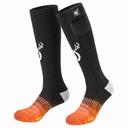
The SNOW DEER pair. Full 7.4V system, heat over the toes and forefoot, multiple levels, washable with the batteries out, and the longest track record of anything on this page. Start it on low when you settle in and only step it up when your feet genuinely cool — that habit is worth more than any spec here.
If the walk in is the cold part
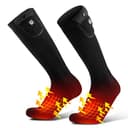
The SAVIOR HEAT pair, which publishes a high stated top temperature it reaches quickly. The practical use is counter-intuitive: leave them off on the walk so you do not sweat into them, then power them on once you are settled and get warm in minutes instead of half an hour. That sequence is also the better scent play, for the reasons in scent control for bowhunting.
If you have never owned a heated sock
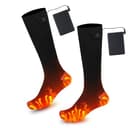
The AiQiKang pair. It is the cheapest way to find out whether powered warmth changes your season, it has four levels, and it is the only pair here that publishes a run time. If it turns out you love them, you will know exactly what to look for in a better pair; if it turns out you do not, you have spent very little.
If you would rather not manage batteries at all
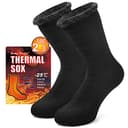
The Busy Socks thermal pair, and there is no shame in it. Nothing to charge, nothing to die, nothing to bulk out your ankle, and the cheapest pick on the page by a wide margin. Pair it with a boot blanket and you have a cold-weather foot plan with no electronics in it — best boot blankets. The catch is real: in deep cold, a thermal sock has no answer that an element does.
Making a sub-$100 pair last a full sit
Since nothing in this band publishes a run time for its high setting, battery management is on you. Four habits do most of the work.
- Hunt on the lowest level that keeps your toes comfortable. Heat draw is not linear with level, and the difference between level one and level four is the difference between a full sit and a dead sock at noon.
- Do not power them on the walk in. You will overheat, sweat, and then cool down wet. Wet feet get cold at any wattage.
- Size your boots around the sock.A heated sock plus a tight boot is a cold foot. If your boots are already snug with a normal sock, fix the boot first — best rubber hunting boots for the money covers which boots have room and which do not.
- Carry the spare battery warm. Lithium cells lose usable capacity in the cold. An inside-pocket spare is a different proposition from one that has ridden in your pack at 15 degrees all morning.
If you are deciding between powered socks and the alternatives rather than between socks, the two comparisons worth reading are heated socks vs hand warmers and boot blanket vs heated socks.
What we left out, and why
The merino pair with app control.It is the best heated sock we track and it was over this page’s cap at the last price refresh — by a margin small enough that it is worth checking the live figure before you settle for a synthetic. Wool that keeps insulating when the battery dies is the one thing money buys here that you cannot work around, and it is ranked in best heated socks.
Any claim about how warm these get on your foot.One maker publishes a top temperature as a stated figure; nobody publishes a temperature at the toe inside a boot, in the cold, with a battery three hours in. We have not measured one and we will not invent one. Every number on this page is read from a maker’s or a listing’s own published data and dated — here is exactly what we do instead.
Socks sold only as 12V or AA-battery sets. We track none with a verified live offer, and a heated sock running on disposable AAs is a worse proposition than a cheap rechargeable pair: you pay forever and the heat is weak.
The cheapest listings with no published electrical spec at all. There is a tier below the budget pick here where the listing publishes neither voltage, nor capacity, nor level count. We do not rank a battery-powered garment that will not say what is in it.