How we scored “for the money” here
Value is not the lowest price and it is not price divided by features. In rubber boots it comes down to four questions, in this order.
- Does it publish a number you can plan around? A comfort range is the only published figure in this category that speaks to outcome rather than content. Two boots here have one. Everything else asks you to translate millimeters and grams into a guess.
- Is the construction the cheap part or the expensive part? Neoprene over rubber is the normal build and it is good. Hand-laid natural rubber is the premium build and it resists thorns and barbed wire far better. You can see which you are buying on every listing here, and it explains most of the spread.
- Will it still fit in three years? Only one boot here has an adjustable gusset. Fit is the single most common reason a hunting boot gets replaced early, and a boot replaced early is expensive no matter what it cost.
- How much of the season does it cover? A boot that works from October to January earns its price across three months of sits. A specialist boot that is perfect for two warm weeks has to be much cheaper to make sense, which is exactly the trap at the premium end of this category.
What we deliberately did not score: warmth we have not felt, durability we have not tested, and “comfort.” We own none of these boots and we have walked in none of them. Every figure above and below is read from the maker’s or the listing’s own published data and dated — here is exactly what we do instead.
Why rubber at all, and why it belongs on a scent-control hub
A rubber boot is a scent decision before it is a warmth decision. The part of you that touches the ground is the part that leaves the trail a deer puts its nose in, and leather and fabric panels hold and release odor in a way a rubber lower does not. That is the whole argument of how to control boot scent, and it is why every boot on this page has rubber against the dirt.
It is also why the cheap pick being black rather than camo costs you nothing. Whitetails are dichromats with poor discrimination in the red and orange end of the spectrum — do deer see color— and a boot is below the vegetation line for most of a hunt anyway. Pattern on a rubber boot is a preference. Scent containment is the function.
The flip side, and the mistake that costs hunters more than any boot choice: a rubber boot that makes you sweat on the walk in becomes the thing generating odor. If your hunts start with a mile of walking, read hunting boots vs hiking boots before you spend, because the right answer may be two pairs of footwear rather than one better boot.
The two-boot plan, and when it is the cheaper answer
Hunters ask which single boot does everything. In rubber, no boot does, and the spec sheets say so plainly: the warmest boot here publishes a comfort window that tops out at 30 F, which means it is the wrong boot for an October morning, and the two uninsulated boots are the wrong boots from November onward.
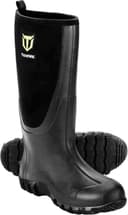
So price the pair, not the boot. Buying both TIDEWEs — the uninsulated 6 mm for early season and the 800 g for the cold — lands in the same neighborhood as one Woody Max and under the price of one Arctic Pro, and it covers more of the season than either single boot does. That is the best raw value on this page if you can live without a published temperature range and without a long brand record behind the boot.
There is a scent dividend in the two-boot plan as well, and it is the reason we keep recommending it: the early-season boot you sweat into in October is not the boot you put on for a December sit. One pair stays dry while the other airs out. Store both the way you store the rest of your gear — how to store hunting clothes scent free.
Where the money stops buying anything
Three places, and knowing them is most of what a value page is for.
- Camo on a rubber boot. A meaningful share of the price spread in hunting footwear is pattern and branding. The deer cannot resolve it and your boots are in the grass. Spend the difference on insulation or on a second pair.
- Insulation you will not sit still in.Comfort ranges assume you are walking. Sitting motionless in a blind at 20 F is colder than walking at 0 F, which is why a boot rated far below zero can still leave your toes numb on a December sit. More grams is not the fix for a cold all-day sit — a boot blanket, a heated sock under $100 or a floor that is not frozen ground is.
- Height you do not wade in. Eighteen inches of boot is worth real money in flooded timber and worth nothing on a dry field edge, where it mostly adds weight and heat. Buy the height your ground actually demands.
Which of these is yours
If you want one boot and you hunt a normal whitetail season
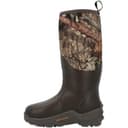
The Woody Max. The published −40 F to 40 F window is the widest on the page and it is the only one that covers both ends of a season on paper. Watch the calf: the stated maximum is around 17 inches with no adjustable gusset, so the fit is the fit.
If the budget is firm and the cold is real
The TIDEWE 800 g. Seven millimeters of neoprene and 800 g of insulation at the lowest insulated price here. You are buying material rather than a published range, and you are buying from a value brand with no long field history, which is the honest risk.
If you are buying your first pair of rubber boots
The TIDEWE 6 mm. Cheapest way to find out whether a rubber boot suits the way you hunt, with a steel shank for arch support on uneven ground. Treat it as a mild-weather and spring-turkey boot and you will not be disappointed.
If your season ends with all-day December sits
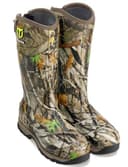
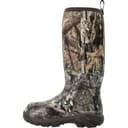
The Arctic Pro, and it is the one place on this page where more insulation is genuinely the answer: 8 mm of neoprene against the Woody Max’s 5 mm and a published range to −60 F. It is far too warm for early season, so it only makes sense as the cold half of a rotation. Pair it with how to stay warm in a ground blind.
If every boot you own dies at the calf
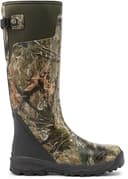
The LaCrosse Alphaburly Pro 18. The adjustable rear gusset is the only real answer to a boot that gapes or binds, the hand-laid rubber is the most puncture-resistant build here, and the same boot is sold from uninsulated up to 1,600 g. It is also around five pounds a pair insulated, so it is not a long-walk boot. The full substitute discussion, including the complaints each boot fixes, is in Muck Boots alternatives.
What we left out, and why
The Dryshod Viperstop.It is a good boot and the best warm-weather rubber build we track — hand-laid rubber for snake country, a wicking airmesh lining instead of fleece, a gusset for bigger calves — and it is the weakest value case on the page precisely because of that: a premium price for a boot with no insulation at all, useful in a narrow part of the season. It is ranked on its merits in best rubber hunting boots.
Leather and upland boots. We do not stock one, so we will not rank one. If you are walking miles of hill country rather than slipping into a blind, a lace-up leather boot may well be the better purchase, and the honest place to start is our comparison of hunting boots vs hiking boots, not a page about rubber.
Sizing advice we cannot source.Several boots here are listed with every size and camo as its own Amazon variant, and listing-level sizing notes are not maker-published fit guidance. Confirm the size in the listing title before you order, and read the maker’s own size chart rather than ours — we do not have one.
Any claim about durability. Neoprene uppers tear on barbed wire more easily than hand-laid rubber, and that is a construction fact both makers publish. How long any of these lasts in your briars is not something we can know without owning them for several seasons, and we do not.