What elevation actually buys you
Two things, and only one of them is the view.
Your scent cone leaves higher.This is the real reason to be ten feet up. It does not make you invisible to a nose — thermals pull scent down in the evening and swirl it in broken terrain — but it buys you distance before your scent reaches the ground a deer is standing on. The mechanics are in how to hunt thermals and scent control for elevated stands.
Your sight lines clear the cover.Over standing corn, across a CRP field, down a cut bean field with a rise in it. This is the half of elevation hunters notice first and value most, and it is genuinely worth money on flat ground with tall cover — how to hunt standing corn.
What it does notbuy is concealment. A box on stilts in the middle of a field is the most conspicuous object on the property, and deer habituate to it rather than fail to see it. That is why every one of these blinds wants to be tucked into a treeline, brushed in at the base, and set up months before you hunt it — where to place a ground blind applies to towers too.
The specs that decide it, and the ones nobody publishes
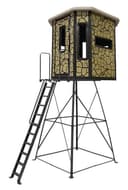
- Tower included: yes or no.The single most expensive line item in this category. One pick here publishes a tower in the box; two publish “Tower included: No”; one needs no tower at all; one is the tower hardware and nothing else.
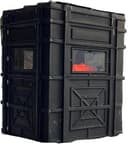
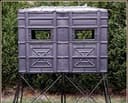
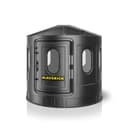
- Wall material. Steel outlasts hard plastic, which outlasts fabric on a frame, which outlasts nothing. The Muddy publishes steel; the Hughes blinds publish hard-sided construction with slide windows; the Maverick publishes hard-sided at 7 feet of height.
- Footprint, honestly read.A 4x4 is a solo blind with a gun and a heater in it, whatever the capacity line says. A 4x8 seats two in chairs with space between them — and needs a stouter, more expensive tower to carry it.
- Window operation.Slide windows open silently. This is the one everyday advantage a hard-sided blind has over a fabric blind that nobody advertises: no zipper ripping open over a deer’s head.
- What is not published, on every single pick.Interior standing height and shipping weight are blank on all five listings we read, and the bracket set publishes no rated load. Measure your own height against the published footprint, arrange freight before you order, and treat a homemade tower’s safety as your own engineering problem.
Buy the blind, build the tower, or buy neither
Buy the blind and the tower together
The Muddy Bull with the Elite tower, and understand the commitment: freight delivery, a serious multi-person assembly, and a levelled, anchored site. It costs several times a complete fabric tower blind. For a hunter who owns the ground and intends to hunt the same funnel for fifteen years, it is the only pick here that is finished when it arrives.
Buy the blind and source a tower separately
The Hughes Enforcer 4x4 or the Clubhouse 4x8. Both publish “Tower included: No,” which is a real cost and not a footnote. The advantage of this route is that you can match the tower height to the terrain and upgrade it later; the risk is that you underbuy the tower for the blind, which is how a 4x8 box ends up on a platform that moves in wind. Our value-across-the-range view of the whole category is in best box blind for the money, and the full category is in best box blinds.
Build the tower yourself
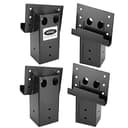
The Mofeez brackets, which buy the one thing that is genuinely hard about a wood tower: the compound angle that splays the legs outward and makes it stable. Everything else is lumber and labour, and it is by far the lowest cost per square foot of finished blind. You choose the height, the window layout and whether to insulate it. Two cautions: there is no published load rating, so your build and your footings are the safety system; and it is permanent, so a bad site choice is a permanent bad site choice.
Skip elevation entirely
A legitimate answer, and the Maverick XL is the pick for it: a full-height hard-sided blind with 360-degree windows that you walk into. No ladder, no tower, no fall risk, and it hunts any wind. The price is that your scent goes straight out at nose height, so wind discipline becomes everything — how to check the wind hunting. The broader comparison is in ground blind vs box blind.
Safety, because this category has a ladder in it
Every elevated blind involves climbing, and falls from elevated hunting positions are the commonest serious hunting injury there is. The rules do not change because the platform is a box: use three points of contact, wear a harness on the ladder as well as in the blind where a rail system allows it, inspect the ladder bolts and the footings every season, and never climb with a loaded firearm or a bow in your hand. Our full treatment is in tree stand safety tips and how to descend safely from a tree stand.
What we left out, and why
Both complete fabric tower blinds, and one hard-sided panel blind. Three products in our registry that belong in this conversation — two quad and tripod tower blinds that ship the tower and the enclosure together, and a four-panel HDPE blind — had no live offer on the day this page was published. They are the cheapest honest route to an elevated enclosed blind when they are in stock, and we will not rank a product you cannot buy. They remain in best box blinds on their published specs.
Ladder stands with shooting rails. A two-man ladder stand is elevated and far cheaper than anything here, but it is a seat in the open rather than an enclosure. Ranked separately in best ladder stands.
Every dimension no maker published.Interior height, weight and window counts are blank across this category and we print “Not published” rather than estimating from a photograph. We own no units and run no field tests — here is exactly what we do instead.