How to work out your own number
Do this at ground level, before the season, with the sticks and the lineman’s rope you will actually hunt with. It takes twenty minutes and it replaces every estimate on the internet with a number that is true for your body.
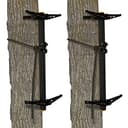
- Hang one stick at the height you can comfortably reach and attach from the ground. Mark where the top step sits.
- Standing on that top step with your lineman’s belt on, hang the next stick as high as you can comfortably reach and still attach it properly — not as high as you can stretch. Mark the new top step.
- Repeat once more. You now have your real height-per-stick, measured with your stride, your reach and your gear.
- Divide your target platform height by that figure and round up. That is your stick count. Then add an aider or a fourth stick as margin, because trees lean and the ground is rarely flat where you want to climb.
Most hunters who do this discover two things: that they were overestimating how high they could safely reach, and that their comfortable platform height is lower than they assumed. Both are useful corrections. If the number surprises you, the companion question is how high a tree stand should bein the first place — height buys scent and sightline advantages that flatten out quickly above about twenty feet.
Fewer sticks is not automatically better
Minimalism is popular in mobile hunting and it has real benefits: less weight, less bulk, fewer attachments, fewer noises. But there is a floor under it, and it is a safety floor rather than a style one. Each stick you remove adds a transition — a moment where you are moving gear and your weight at the same time. Taken to its end point, that is one-sticking, which is a legitimate technique and a demanding one. The one-stick vs multi-stick comparison lays out the trade honestly, and a ring of steps versus one stick covers the quietest end of the spectrum.
The arithmetic that matters: the Tree Stand Safety Awareness Foundation cites a ten-state study in which 99 percent of fall victims were not attached to the tree and 86 percent wore no harness, and Wisconsin’s DNR reports that roughly one in four bowhunters have fallen or nearly fallen. Stick count does not change those numbers — staying connected does. Whatever you carry, you stay attached with a lineman’s rope for every attachment and every step, up and back down, and you treat the descent with the same care as the climb.
What else your stick count affects
Pack weight and noise.Sticks are usually the heaviest and loudest part of a mobile kit — heavier than the saddle, bulkier than the platform. Going from six sticks to four is a bigger difference to your walk-in than any other single change you can make, which is why packing for a mobile hunt spends most of its time on how sticks are stacked and strapped.
Which trees you can hunt.More sticks means more options — you can climb past a limb, work around a lean, or get above cover that would otherwise rule a tree out. A tight stick count quietly narrows your tree selection, which matters more than it sounds: tree choice is the variable that decides most saddle hunts, as choosing a tree for saddle hunting explains.
Your platform setup.The last stick is the one you stand on while you hang and level the platform, so its position relative to your platform height matters more than the others. Get that wrong and the whole climb feels awkward even with the right stick count — choosing a saddle platform and the platform picks cover the pairing. If you also hang a bow or gear from the tree, a bow holder is what keeps your hands free during exactly these transitions.
Whether a saddle is the right tool at all.If your honest answer is “as few as possible, because I hate the climb,” the useful comparison is not between stick counts — it is saddle versus ground blind. Plenty of hunters kill more deer from the ground, and nothing about going mobile is compulsory.