Blind & Brush

Best Hunting Rangefinder Under $100

Under $100 buys you a number. It does not buy you a published accuracy figure — not one unit in this band states one. The three worth owning anyway, and how to use a cheap rangefinder so the gap stops mattering.

By Stephen V.Last updated How we pick

Buy the WOSPORTS 1500-yard unit. It is the only rangefinder under $100 here that publishes both a magnification (6x) and a dedicated bow-hunting mode alongside angle, speed and scan — which is the feature set a blind or stand hunter actually uses. Six-power glass matters more than the headline yardage: you have to put the reticle on a specific deer standing in front of brush, and a 4x unit makes that harder than the spec sheet suggests.

The budget pick is the TIDEWE 700-yard rechargeable — the cheapest unit here, and the only one that does not run on a coin cell. A CR2 battery that dies on a 20-degree morning is the most common way a cheap rangefinder fails, and 700 yards is five times further than any shot taken from a ground blind. If you want one device that also works on a golf course, the Gogogo Sport Vpro GS03 is the third pick.

Now the part this price band does not advertise. Not one of these three publishes an accuracy figure. No plus-or-minus yardage, no test condition, nothing. For comparison, Vortex publishes accuracy specifications for the Denali 1000 one step up the ladder, and Nikon publishes +/- 0.5 yd under 600 yd for its PROSTAFF 7i. That gap, not range, is the real difference between this band and the next one up. Prices come from the live price layer — check the “as of” stamp under each button.

How this is funded: we earn a commission if you buy through our links, at no extra cost to you. It never changes which product we recommend, and we’ll tell you plainly when we’d skip one. Full disclosure.

Quick picks

Ranked on published specs, concealment fit and value. Select a row to jump to the full write-up. We have not field-tested this gear — here is exactly what we do instead.

#ProductBest forPrice
1
WOSPORTS 1500-Yard Hunting Rangefinder with Bow Mode

WOSPORTS 1500-Yard Hunting Rangefinder with Bow Mode

The cheapest unit here that publishes a bow mode and an angle reading, which are the two functions a blind hunter actually needs. At roughly a third of the Leupold's price it buys the right features; what it does not buy is a published accuracy tolerance, and that omission is the honest reason it does not outrank the units that publish one.

Best overall under $100
$56.99 · View on Amazon

$99.9943% off

Price as of November 21, 2026. #ad How we’re funded

2
TIDEWE 700-Yard Rechargeable Hunting Rangefinder

TIDEWE 700-Yard Rechargeable Hunting Rangefinder

The pick for a hunter who hates coin cells, which is a more reasonable preference than it sounds — a CR2 that dies on a December morning is not replaceable from a blind. This one recharges, comes in camo, and publishes a 700-yard ceiling that is many times any shot you will take through a blind window.

Budget pick: cheapest, and rechargeable
$55.99 · View on Amazon

$79.9930% off

Price as of November 21, 2026. #ad How we’re funded

3
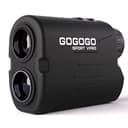
Gogogo Sport Vpro GS03 Laser Golf/Hunting Rangefinder

Gogogo Sport Vpro GS03 Laser Golf/Hunting Rangefinder

The honest answer for someone who genuinely wants one unit on the course and in the blind, which is a real buyer and not a compromise we invented. The listing publishes 1,000 yards, 6x magnification, a slope mode and flag-lock with vibration out to 300 yards — so it has the golf features a dedicated hunting unit lacks and the slope arithmetic a hunter needs. What it does not publish is an accuracy tolerance, and on a dual-purpose unit that omission matters more, not less.

Best if it has to do golf too
$56.99 · View on Amazon

$79.9829% off

Price as of November 21, 2026. #ad How we’re funded

The picks in full

#1Best overall under $100Budget laser rangefinder

WOSPORTS 1500-Yard Hunting Rangefinder with Bow Mode

The cheapest unit here that publishes a bow mode and an angle reading, which are the two functions a blind hunter actually needs. At roughly a third of the Leupold's price it buys the right features; what it does not buy is a published accuracy tolerance, and that omission is the honest reason it does not outrank the units that publish one.

About that 1,500 yards. Maximum-range claims across the whole rangefinder market are measured against large reflective targets, not deer. Treat the published figure as a ceiling under ideal conditions and expect substantially less on a brown animal in brush — which is irrelevant at blind distances and worth knowing before you buy on yardage alone.

Strengths

  • Publishes a bow hunting mode plus distance, angle, speed and scan modes at a budget price
  • 6x magnification and a stated 1,500-yard ceiling, far beyond any blind shot
  • Cheap enough to keep a second one in the blind bag

Trade-offs

  • No published accuracy tolerance — the single most important rangefinder spec is missing
  • No published glass, coating or weather-sealing detail either
  • Budget rangefinders are where lifetime warranties are not, so treat it as replaceable
Magnification6x
Max range (stated)1500 yd
ModesBow hunting, distance, angle, speed, scan
AccuracyNot published
Water resistanceNot published
BatteryNot published

The spec that matters. Verify a budget rangefinder before you hunt with it: pace off 20, 30 and 40 yards in the yard and range each one. A unit that reads consistently within a yard at hunting distance is all a blind shot needs, and five minutes in the driveway is the only way to know.

Specs read from the product listing, on October 10, 2026. “Not published” means the maker does not state that figure.

#2Budget pick: cheapest, and rechargeableBudget laser rangefinder (rechargeable)

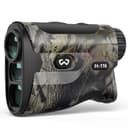
TIDEWE 700-Yard Rechargeable Hunting Rangefinder

The pick for a hunter who hates coin cells, which is a more reasonable preference than it sounds — a CR2 that dies on a December morning is not replaceable from a blind. This one recharges, comes in camo, and publishes a 700-yard ceiling that is many times any shot you will take through a blind window.

Strengths

  • Rechargeable battery: no CR2 to source in the dark on a cold morning
  • Camo body, which is one less dark rectangle moving behind a blind window
  • 700-yard stated range is far more than a blind hunter will ever use

Trade-offs

  • No published accuracy figure, the same gap as every budget unit here
  • Rechargeable also means it can be flat when you need it — charge it the night before
  • TIDEWE publishes no angle-compensation detail, so treat elevated-shot math as your job
Max range (stated)700 yd
PowerRechargeable
FinishCamo
AccuracyNot published
Angle compensationNot published
MagnificationNot published

The spec that matters. Rechargeable is the right trade for a hunter with a routine and the wrong one for a hunter who throws gear in a truck in October and finds it in November. Charge it the night before every hunt, or buy the coin-cell unit and keep a spare battery in the blind bag.

Specs read from the product listing, on October 10, 2026. “Not published” means the maker does not state that figure.

#3Best if it has to do golf tooDual-purpose golf and hunting rangefinder

Gogogo Sport Vpro GS03 Laser Golf/Hunting Rangefinder

The honest answer for someone who genuinely wants one unit on the course and in the blind, which is a real buyer and not a compromise we invented. The listing publishes 1,000 yards, 6x magnification, a slope mode and flag-lock with vibration out to 300 yards — so it has the golf features a dedicated hunting unit lacks and the slope arithmetic a hunter needs. What it does not publish is an accuracy tolerance, and on a dual-purpose unit that omission matters more, not less.

Strengths

  • Publishes both halves of the job: slope for elevation and flag-lock with vibration to 300 yards for a pin
  • 1,000-yard stated ceiling and 6x magnification, far beyond any blind shot
  • Costs roughly a third of a premium hunting unit, so the dual use is a real saving rather than a theory

Trade-offs

  • No published accuracy tolerance — the one rangefinder spec you would most want before trusting a 40-yard arrow
  • Flag-lock is first-target priority behavior, which is exactly wrong for ranging a deer standing behind brush
  • Slope mode makes it non-conforming for tournament play unless it is switched off, so check your competition's rules
Magnification6x
Max range (stated)1000 yd
Slope / elevation modeYes
Flag-lock with vibrationTo 300 yd
AccuracyNot published
Angle-compensated hunting modeNot published
Water resistanceNot published

The spec that matters. A dual-purpose unit is a target-priority compromise before it is anything else. Flag-lock exists to grab the NEAREST reflective object; ranging a deer in timber asks for the opposite behavior, because the nearest object is the brush in front of him. Range the ground he is standing on, not the deer, and the compromise stops mattering.

Specs read from the product listing, on October 31, 2026. “Not published” means the maker does not state that figure.

What you are actually buying

You are buying the end of guessing, not a precision instrument.

A hunter in a ground blind takes shots at distances that are known in advance, through a fixed set of windows, at landmarks that do not move. That is a completely different problem from a western hunter ranging an animal across a canyon, and it is the reason a unit from this band is genuinely sufficient for a lot of hunting, and would be a poor choice for a mountain rifle hunt.

The workflow that makes a cheap unit good enough is simple, and it is the whole point of this page: range your lanes before daylight, not the deer. Pick the three or four objects a deer is most likely to stop beside — the fence post, the near edge of the trail, the scrape, the corner of the food plot — range them while nothing is watching, and write the numbers on a strip of tape inside the window frame. Now the accuracy figure nobody publishes stops mattering, because you are not asking the unit to get a single reading right with a buck standing there and your heart going.

The specs that matter in this band

Magnification, not maximum range

Both the WOSPORTS and the Gogogo publish 6x. The TIDEWE does not publish a magnification at all. This is the spec that decides whether you can hold the reticle on the right object — a deer in front of a brush line, rather than the brush line — and it is also what makes a rangefinder usable as a small monocular for a quick look.

Angle compensation, which a bow hunter cannot do without

From an elevated stand, the straight-line distance to a deer is longer than the horizontal distance your arrow actually flies. An angle-compensated reading (branded TBR/W, HCD or AMR on better units) does that trigonometry for you. The WOSPORTS publishes an angle mode; the TIDEWE publishes nothing about angle compensation; the Gogogo publishes a slope mode intended for golf.

There is a curious regulatory reason the golf units have this feature at all. The Rules of Golf list “measuring elevation changes” under what is not allowedin competition, so slope on a golf rangefinder is built as a switchable, lockable extra — while the same arithmetic is the headline feature of a hunting unit. Full treatment of that quirk, and of which dual-purpose units are worth it, is in hunting rangefinder vs golf rangefinder.

Target priority, which nobody in this band publishes

Better rangefinders let you choose whether the unit reports the nearest or the farthest object in the beam. Nikon’s own description is the clearest statement of why that matters: First Target Priority “allows you to measure the distance of the closest subject” and is useful for a subject in front of an overlapping background, while Distant Target Priority “displays that of the farthest subject” in brushy terrain. Deer stand in front of brush constantly. None of the three units here publishes a target-priority mode, so expect the occasional reading that belongs to the tree behind the deer — take two readings when it matters and discard the outlier.

Power, which is where cheap units actually die

A coin cell in the cold is the failure mode of this whole price band. The TIDEWE is rechargeable, which removes it. On the others, carry a spare battery in the blind bag, and change it at the start of the season rather than discovering the problem on a December morning.

What the next step up the ladder buys

It buys published numbers. One step up, Vortex publishes accuracy specifications and a usable deer-sized-target range for the Denali 1000. A step beyond that, Leupold publishes angle-compensated TBR/W output plus Flightpath, which shows the arrow clearance arc — a genuinely different feature for anyone shooting through a blind window or a hole in the canopy. Neither improves the number you get at twenty yards. Both improve your confidence in a number at eighty.

Which means the honest recommendation is: if your shots happen inside forty yards from a blind, a sub-$100 unit plus pre-ranged lanes is the right spend. If you also hunt open country with a rifle, skip this page and read best hunting rangefinders instead.

How to use a cheap rangefinder well

  • Range the lanes in the dark. Write the numbers on tape inside the window frame or on the limb of your bow. This is the single habit that makes a budget unit behave like a far more expensive one.
  • Take two readings on anything that matters. With no published accuracy and no target priority, a second reading is your error check.
  • Range the ground, not the animal, when you can. A brown deer in brush is the hardest target a laser has; the trail under its feet is easier and the answer is the same.
  • Mind the glass. A laser does not go through a closed blind window, and shooting a reading through mesh will give you the mesh. Range through the open gap you intend to shoot through.
  • Lanyard it to the chair, not your neck.A rangefinder swinging from a neck cord is a hard object that knocks against a riser or a gun stock at exactly the wrong moment — a noise problem covered in how to silence your hunting gear.

What we did not include, and why

Any unit over the cap at the last refresh. This is a price-band page and the band is enforced from the live price layer. The Vortex Denali 1000, the Leupold RX-1400i Gen 2 and the SIG KILO Canyon all sit above it and are in the unrestricted roundup.

Rangefinding binoculars and scope-mounted units. Different category, different budget, nothing under $100.

Phone apps. A phone camera cannot measure distance with a laser, and the GPS-based estimates are not usable at bow range.

Accuracy figures of our own.We own none of these units and we are not going to publish a plus-or-minus number we did not measure. Where the maker does not publish one — which here is all three — the spec table says “Not published,” and that uniform blank across an entire price band is the finding this page exists to state.
Frequently asked questions

What is the best hunting rangefinder under $100?

The WOSPORTS 1500-yard unit, because it publishes 6x magnification plus a dedicated bow mode alongside angle, speed and scan readouts — the feature set a blind or stand hunter uses. Six-power glass is the spec that matters most in this band: you have to hold the reticle on a specific deer standing in front of brush, and lower magnification makes that genuinely harder. If you want the cheapest unit that will not die on a cold morning, the rechargeable TIDEWE is the pick instead.

Are cheap rangefinders accurate enough for hunting?

For blind and stand hunting inside about forty yards, yes — with one caveat that applies to the whole band: not one unit under $100 publishes an accuracy figure, so there is no stated plus-or-minus to rely on. The workaround is the habit good blind hunters use anyway. Range three or four landmarks before daylight, write the numbers on tape inside the window frame, and you are reading a prepared number rather than asking a cheap laser to be exact with a buck standing in front of you.

Can a budget rangefinder really reach 1,500 yards?

Not on a deer. Maximum-range claims across the entire rangefinder market are measured against large, highly reflective targets under good conditions — a building or a hillside, not a brown animal in brush. Expect substantially shorter usable range on game, which is completely irrelevant at blind distances and a good reason not to choose between units on the headline yardage. Magnification, angle compensation and battery type tell you far more about how a unit will perform.

Do I need angle compensation on a hunting rangefinder?

If you shoot a bow from an elevated stand, yes. The straight-line distance to a deer below you is longer than the horizontal distance the arrow actually travels, and shooting the line-of-sight number puts the arrow high. An angle-compensated reading does that trigonometry for you — branded TBR/W, HCD or AMR on better units, and simply an angle mode on inexpensive ones. From a ground blind, where everything is level, it matters much less.

Why does my rangefinder read the brush instead of the deer?

Because inexpensive units do not let you choose which object in the beam to report. Better rangefinders publish a target-priority setting: Nikon describes First Target Priority as measuring the closest subject, useful when the subject is in front of an overlapping background, and Distant Target Priority as reporting the farthest subject for brushy terrain. None of the units under $100 publishes such a mode, so take two readings when it matters, discard the outlier, and range the ground at the deer's feet rather than the animal when you can.

Is a golf rangefinder good enough for hunting?

It can be, and the Gogogo GS03 on this page is here because it publishes both a slope mode and a 1,000-yard range. The quirk worth knowing is why golf units have slope at all: the Rules of Golf list measuring elevation changes among the things not allowed in competition, so slope is built as a switchable, lockable feature — while the identical arithmetic is the headline feature of a hunting rangefinder. What golf units usually lack is a brush-rejecting target-priority mode, which is exactly what a deer in cover demands.

Rechargeable or battery rangefinder for hunting?

Rechargeable, if the choice is between two otherwise similar cheap units. A coin cell losing capacity in the cold is the most common way an inexpensive rangefinder fails, usually on the coldest morning of the season. If you buy a battery-powered unit, replace the cell at the start of each season and keep a spare in the blind bag — it is a two-dollar insurance policy on the only tool that tells you whether a shot is inside your range.

Sources

  • Denali 1000 Laser Rangefinder — published specifications (Vortex Optics) — Vortex's spec table: 6x20mm, 500 yards on deer / 800 on trees / 1,000 reflective, 1-yard accuracy at 100 yards, Horizontal Component Distance (HCD) and line-of-sight modes, +/- 60-degree maximum angle reading, 5.5 ounces, VIP unlimited lifetime warranty (accessed October 10, 2026)
  • RX-1400i TBR/W Gen 2 Rangefinder — published specifications (Leupold) — Leupold's spec table and feature list: 5x21mm, 900 yards on deer, 6-yard minimum, 0.5-yard accuracy inside 125 yards, TBR/W ballistic ranging, and Flightpath — which displays the highest point of the arrow's flight once calibrated to the bow, typical to roughly 70 yards (accessed October 10, 2026)
  • PROSTAFF 7i laser rangefinder and the Target Priority Switch System (Nikon) — Nikon's own published description of the two target-priority modes, which is the mechanical difference between a golf and a hunting rangefinder: First Target Priority mode “allows you to measure the distance of the closest subject” and is “useful when measuring the distance to a subject in front of an overlapping background,” while Distant Target Priority mode “displays that of the farthest subject” for wooded terrain where the subject “may be partly obscured by bushes and undergrowth.” The same page publishes the PROSTAFF 7i's specification: 6x magnification, 8-1,300 yd measurement range, accuracy of +/- 0.5 yd under 600 yd, display in approx. 0.5 second, and switchable Horizontal Distance and Actual Distance display modes (accessed October 31, 2026)
  • Rule 4.3a(1) — Allowed and Prohibited Uses of Equipment (The R&A / Rules of Golf) — The Rules of Golf, Rule 4.3a(1) on Distance and Directional Information. Allowed: “Getting information on distance or direction (such as from a distance-measuring device or compass).” Not allowed: “Measuring elevation changes,” “Interpreting distance or directional information (such as using a device to get a recommended line of play or club selection based on the location of the player's ball),” or using an alignment device. This is why slope is a switchable, lockable extra on a golf rangefinder — and why angle compensation, the same arithmetic, is the headline feature of a hunting one (accessed October 31, 2026)

Keep reading