What the trigger actually does, and who needs it
The Trigger Stick’s mechanism solves one problem: changing height during a hunt, with one hand, quietly. Decide whether that is your problem.
- If your rest height changes, you want the trigger. Spot and stalk, open-country rifle hunting, a hunter who glasses standing and shoots kneeling, anyone hunting broken ground. Nothing below replaces this and we are not going to pretend otherwise.
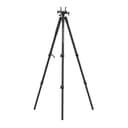
- If your rest height never changes, the trigger is a cost. A box blind, a shooting house, a ladder stand with a rail, a ground blind where you sit in the same chair at the same window every sit. You set the height once in the dark and never touch it again. Here a clamping tripod is strictly more useful, because it buys you something the trigger does not: your hands.
- If you shoot a crossbow, weight-forward balance decides it.A crossbow is nose-heavy and wants to be held rather than balanced on a yoke, which is why a clamp or a wide yoke matters more than height adjustment — best crossbow rest.
The specs to compare, and the ones nobody publishes
Two alternatives here publish a height range: the premium clamping tripod publishes 20 to 59 inches, and the rifle bipod publishes 6 to 9 inches. The other two publish no height range at all, and not one product in this category publishes a weight. We print “Not published” rather than estimating from photographs, and in a category where you carry the thing, an unpublished weight is a real gap. What is published and worth reading:
- Gun clamp, yes or no. Both DeathGrip tripods publish clamping jaws. This is the single biggest functional difference from any Trigger Stick, and in a blind it is an upgrade rather than a substitute.
- Yoke type.The value tripod publishes a switchable yoke that takes a gun or an optic, which is the closest thing here to the Trigger Stick’s do-everything cradle at a lower price.
- Optics mounting. The premium pick publishes a detachable clamp that swaps for an Arca-Swiss plate, so one tripod carries a spotting scope or a camera as well as a rifle. That is a genuine two-jobs-one-purchase saving, and the cost is a part to swap in the dark.
- Leg adjustment. The premium pick publishes independently adjustable legs, which is what you want on an uneven blind floor or a hillside.
Our format-level argument — bipod against tripod, and when each is right — is in bipod vs tripod shooting rest.
Why a rest is a concealment item in a blind
It is easy to file a shooting rest under accuracy. In a ground blind it belongs under movement.
A hunter with no rest holds the rifle up, gets tired, puts it down, picks it up again when a deer appears, and does all of that inside a fabric box. A hunter with a clamped rifle makes none of those movements, and whitetails detect motion far better than they resolve detail. The rest is buying you stillness, and stillness is the whole reason the blind works — deer vision explained, and the discipline side in how to sit all day hunting.
The second half of that is noise. Aluminium legs on a hard blind floor, a clamp jaw against a barrel, a leg lock snapping — all of it carries. Set the rest on a floor mat and set the height before daylight — best ground blind flooring and how to silence your hunting gear.
Which of these four is yours
If you hunt a blind or a shooting house over a field
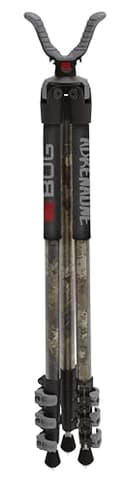
The BOG DeathGrip. Clamp the rifle at first light, point it at the likeliest lane, and spend the next five hours with your hands free. It is the heaviest option here and in a blind you drive to, the weight is irrelevant.
If you want tripod stability for the least money
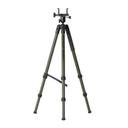
The BOG Adrenaline Switcheroo. No trigger, manual height adjustment, and a yoke that switches between a gun and an optic. It is the honest middle: most of the stability, none of the convenience mechanism, at a lower price than either the Trigger Stick tripod or the DeathGrip.
If the tripod has to glass as well as shoot
The DeathGrip Infinite, for the Arca-Swiss plate and the independently adjustable legs. It is the most expensive pick here — appreciably more than the original DeathGrip — and it earns that only if you own a spotting scope or a long lens you would otherwise need a second tripod for. Glassing optics are ranked in best binoculars for deer hunting.
If you keep forgetting the sticks in the truck
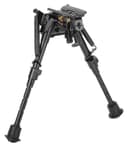
The Caldwell bipod. It lives on the rifle, so it is always there and always aligned, and it costs a fraction of everything else here. Its 6 to 9 inch height is prone or a low rest only — it does not replace a seated or standing stick and we are not going to suggest it does. A gun rest built into the blind itself is often the better answer for seated work: best gun rest for a deer blind.
If what you actually wanted was a cheaper trigger stick
Then buy the monopod version rather than an alternative. Primos publishes the same one-hand trigger with a 35 to 65 inch range in a lighter, cheaper package, and it doubles as a walking and glassing stick. The cost is that one leg does not steady side-to-side sway for you.
What we left out, and why
Every rest not in our registry. We rank only products we hold with a verified listing, and we invent nothing to fill a slot. If a brand you expected is missing, that is why.
Sandbags, packs and window rests. The cheapest steady rest in existence is a pack on a window frame, and it costs nothing. That is a real answer and it is argued in best gun rest for a deer blind.
Any accuracy claim.No group sizes, no stability testing, no “steadier than” measurements. We own no units and we have shot nothing from any of these. Everything above is read from published specs and argued as buyer fit — here is exactly what we do instead.